Showing posts with label Ardennes. Show all posts

Saturday, May 23, 2015

38. Feeling Better At Home


May 23, 1945
The Entry in My Grandmother's Diary for the Day

Got a letter from Buddy that he wrote on VE Day.
So now I feel better.

Take this comment as a follow up to the one she wrote on VE Day:
O God just think of the mothers that their boys won’t be coming home
and realize that for the previous 15 days, over two weeks, she had no doubt been holding her thoughts, prayers and fears deep inside. She never commented on it in the diary. The dread and anxiety must have been overwhelming. Or perhaps in the past nearly nine months she had found a way to live without thinking about it. Perhaps that is why the daily entries in the diary are often just the mundane.

Today, she could feel better. What a relief!

But with all the elation and relief, the dread must have remained. The war was not over. Germany had surrendered; Japan fought on. Did they know that a massive invasion, far greater than D-Day was being planned? Were they all just living in the uncertainty of what  troops would be transported to the Pacific for an invasion of Japan?

What we do know is that for the next several months the Tigers would remain in Austria, relaxing, waiting, wondering, and being an occupation force, albeit a friendly one.


Obviously I am not sure this was in the letter, but it, along with the other two I posted on VE Day could very well have been there.
 

Friday, May 8, 2015

37. VE Day

May 8, 1945
The entry in my grandmother's diary for the day:
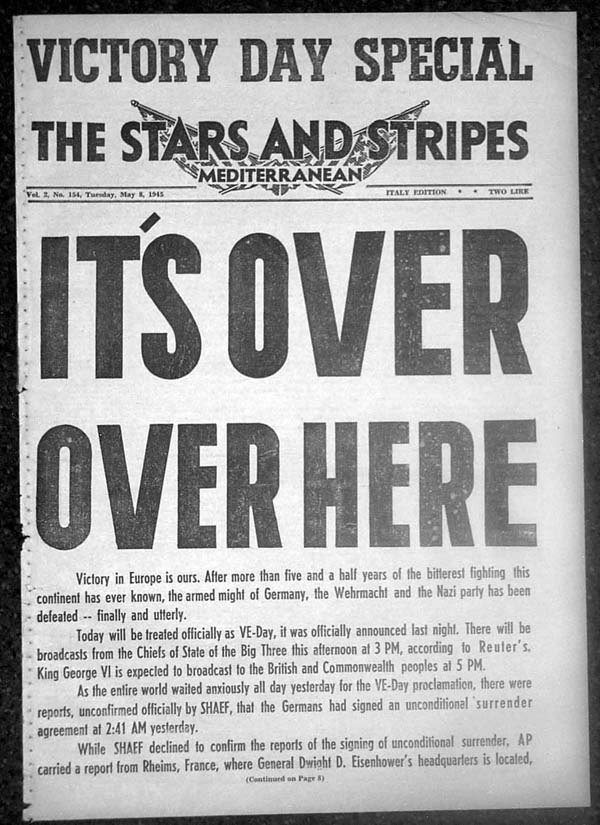
Tuesday- This is V.E. Day. The war is over and O God just think of the mothers that their boys won’t be coming home.
From Nichols:
General Paul Newgarden's careful pre-battle training paid huge dividends and General Morris' leadership propelled the Division through every battle with distinction. The price paid for victory was dear. Tigers' losses were heavy, Almost 5,000 were killed or wounded. The Tigers' combat achievements are a matter of record. More that 56,000 enemy were taken prisoner and 650 towns and cities were captured. More important, the Tigers played a key role in many of the war's greatest battles. The epic stand at Bastogne [note: only recently receiving the credit] will never be forgotten nor will the spectacular successes in the Saar-Moselle Triangle be overlooked by military historians. The capture of Trier was most important in the U. S. Third Army's effort to pierce the vaunted West Wall. And finally, every step of the way from Cherbourg to the Brenner Pass, a distance of 600 miles, was made possible by the Tigers' courage, initiative, and persistence. They has met and defeated the enemy's best. Hitler's earlier boast that American soldiers would never stand and fight must have provided slim comfort to the Nazi commanders who, one by one, capitulated in late April of 1945.

Two postcards sent by my father to his family back in Pennsylvania of the Garmisch-Partenkirche area where they ended the war.


Monday, May 4, 2015

36. The Last Kilometer


1 May 1945
VE Day for the Tigers

From Nichols:
At Ulm, they had turned south once more and, attacking into the rugged Alps on two parallel routes, [the Tigers] had reached Mittenwald on one route and had captured Imst in Austria after crossing the border at Fussen on the other when the war ended.

Prior to April 30, a final Tenth Armored Division Field Order was issued which called for the capture of Innsbruck, Austria. However, the Germans had already blown out great chunk of the road…. [T]he Innsbruck Field Order had to be abandoned…. So intent were the Tigers in grinding out the last mile, that they even tried to roll their tanks over the railroad tracks. The going was extremely difficult, however, as the steel rails did not match the width of the tank tracks…. The last kilometer was now a matter of record anyway. The big fight was over. And Garmisch-Partenkirchen, in the opinion of the Armoraiders, was a fine place to end the war on this, the last day of April of 1945. The final major battle operation of the Tiger Division consumed seven weeks. This period was marked with continuous combat, sleepless days and nights, sizzling speed, strained nerves, rain, snow, mud, and cold. But at last, the ordeal was over.

Elsewhere in the European Theater:
April 29: Adolf Hitler and Eva Braun exchange wedding vows in Adolf Hitler's underground Berlin bunker.

General Vietinghoff, the German commander of Axis forces in Italy, signs documents surrendering to the Allies.

April 30: The newly wed Hitlers commit suicide in the Berlin bunker. Joseph and Magda Goebbels follow suit, murdering their six children before taking their own lives.

Soviet Union forces capture the Reichstag.

May 1: Admiral Karl Dönitz, Adolf Hitler's handpicked successor, establishes a government in Flensburg to control Nazi Germany following Adolf Hitler's suicide.

May 2: Some 490,000 German soldiers in Italy lay down their weapons, honoring the terms of the unconditional surrender signed by Vietinghoff three days earlier.

May 3: Red Army units link up throughout Berlin as German resistance ends, completing the capture of the capital of the Third Reich.

Hamburg, Germany, and Innsbruck, Austria, fall to the Allies.

May 4: German troops surrender en masse throughout northern Germany and the Netherlands.

May 5: German and Allied officials meet in Reims, France, to reach agreement on the terms of Germany's capitulation.

The German army lays down its weapons throughout Bavaria.

U.S. forces liberate French and Austrian officials -- including premiers Reynaud, Daladier, Blum, and Schuschnigg -- from captivity in Austria.

Friday, May 1, 2015

35. End of April Report

After Action Report
80th Medical Battalion
10th Armored Division
1 April – 30 April 1945

There were 31 officers and 364 enlisted men, four less than in March. During the month three enlisted men of the battalion were killed, two officers and four enlisted men were wounded and four were reported missing. Twenty-one reinforcements were assigned to the battalion.

At all three clearing stations of the battalion in April 1945 there were:

2267 admissions (nearly 600 less than March)
153 were returned to duty
19 died in the stations
1987 were transferred and
9 remained in station on 31 March

These numbers were lower than March, indicative of the overwhelming force of the Tigers in the movements of April and the decreasing efficiency of the German troops. More than half of the admissions for the month occurred by the 12th. Captain Loomis commented that the figures are the sum total “of those of the clearing stations and include personnel of units attached or supporting the division and enemy personnel cleared through division medical installations as well as 10th Armored Division personnel.

It was reported that providing both expendable and non-expendable supplies was adequate during the period. In addition, medical evacuation channels functioned efficiently during the period.

Recommendations:
(1) That medical personnel supporting combat troops not be assigned to screen and process enemy hospital installations, but that this chore be given to a static unit.
(2) That the replacement of medical officers and medical administrative officers be expedited in the case of units actively engaged in combat.

Fredrick D. Loomis
Captain, MAC.,
Battalion S-3

Monday, April 27, 2015

34. A Liberating Unit


According to the US Holocaust Museum:
 As it [The Tenth Armored] drove into the heartland of Bavaria, the "Tiger" division overran one of the many subcamps of Dachau in the Landsberg area on April 27, 1945.

The 10th Armored Division was recognized as a liberating unit by the US Army's Center of Military History and the United States Holocaust Memorial Museum in 1985.
-Link
It seems there were six camps in the Landsberg area. First, some of what  is reported at Wikipedia:
The American forces allowed news media to record the atrocities, and ordered local German civilians and guards to reflect upon the dead and bury them bare-handed. After the liberation of the camp it became a displaced person camp. Consisting primarily of Jewish refugees from the Soviet Union and the Baltic states, it developed into one of the most influential DP camps in the Sh'erit ha-Pletah. It housed a Yiddish newspaper (the Yiddishe Zeitung), religious schools, and organizations to promote Jewish religious observance. Tony Bennett was one of the soldiers who liberated the camp.
-Link
U.S. Soldier at Gate of Landsberg. USHM
I gather that the 103rd Infantry Division was one of the major units. Here's some of their report:
From REPORT AFTER ACTION: The Story of the 103D Infantry Division, pp. 131-135

At Landsberg the men of the 103d Infantry Division discovered what they had been fighting against. They found six concentration camps where victims of the super race had died by the thousands of atrocities, starvation, and exposure. The grounds of the camp were littered with the skeletonized bodies of Jews, Poles, Russians, French, and un-Nazified Germans. Every evidence was that they were only the latest of untold thousands who had suffered and died in these six concentration camps, a few among the hundreds which dotted Grossdeutschland. German civilians who were forced by the 411th guards to pick up these wasted bodies for decent burial sniveled that they had not known such things existed. They had not known, yet they had spent their lives in this town of 30,000 which was ringed by six horror camps.
-Link
The 103rd, it should be noted, was, along with the 44th Infantry and the Tenth Armored, working together on a combined spearhead, the Tenth's armor leading the way.

Some videos are archived at the US Holocaust Museum. Here's a link to one of them.

From all I can find, it would appear that my Dad's company was most likely with CC B during this time and in all probability was not part of the liberation of the camp. I wouldn't be surprised, however, that when the Division was reunited all kinds of stories were shared. It is possible however that he was with CC R, the reserve command, which was near Landsberg during this time.

Nichols, interestingly, does not appear to discuss the concentration camp liberation in Impact. He does relate a story of liberating a POW camp where some former Tigers were held following Bastogne. I may continue to explore this. With my Dad married to a Jewish woman from Brooklyn, I would venture a guess that he may have had some interest in this.

Saturday, April 25, 2015

33. To the Danube

This is part of a series following my father's 10th Armored Division in World War II seventy years ago. He was a medic with the 80th Medical Battalion assigned to the 10th Armored, part of Patton’s Third Army.


The Tenth processed their 2,000 prisoners from Crailsheim and sent them to the rear. They were given a new battle assignment. They were to shift their attention and combat power toward Heilbronn where the fighting was continuing.


CC A was directed to seize Oehringen while CC B was placed in "reserve" on a two-hour alert.

12 - 15 April
When forces entered Oehringen they were met with fierce resistance. As Nichols reports it,
Nazi fanaticism was slow to die as Wehrmacht and civilians alike resisted with renewed determination.
Heavy and timed artillery bursts were ordered and the efforts prevailed with the town captured on 13 April. When all the units met with the infantry units east of Heilbronn that mission was ended.

Heilbronn, April 1945
16 - 24 April
It was now time to make the move south toward the Danube and Austria. For several days there were obstacles that acted as hidden allies of the enemy. The minefields, roadblocks and blown bridges, says Nichols, "strained the already overworked Tiger engineers' efforts to clear a path for continued advance." By April 18, things began to move and all three Combat Commands became a formidable array of six armored columns. Town after town was captured. On April 19 the terrain of steep hills and deep valleys slowed the advance but later in the day the Tigers again triumphed and forged ahead 17 miles to the Rems River.

The plateau could have been easily defended by the enemy. But the Germans were sure that the Americans would attack from the west and were thus unable to halt the advance from the north.

CC B crossed the river after seizing two bridges while, to the west CC A hit a 40 MPH pace as a result of Tigers who carried a power saw to rip through roadblocks. At Lorch they scared of an enemy plane about to land and an enemy train. The train got up steam and raced away surprised by the Tigers in the town. Movement of all Combat Commands quickly captured more territory. By April 22 all were closing in on the same target of Kircheim and burst ahead to the Danube at Ehingen.

Stuttgart was virtually surrounded. Harassment of the enemy continued. The capture of Kircheim marked the end of German resistance in the area as more than 400 prisoners were taken and, more importantly, the Stuttgart-Munich autobahn was cut. Nichols writes then,
One of the most important days in the Tenth's memorable history was April 22, the day Chamberlain's forces steamrolled to the Danube. By midnight they succeeded in capturing a bridge at Ehingen. Then on April 23 [they] destroyed a German supply column.... On April 24 the Reserve Command sped across the [Danube] and headed for Ulm. At this point the Tigers were further south than any other American unit.... The Third Reich was almost a dead government now, as allied armies to the north were inflicting terrible punishment on the beaten enemy. The Tenth Armored was no poised above the great National Redoubt, an area which the Germans claimed could never be captured by the Americans. However, this claim, along with their hopes for a "thousand Year Reich" died when the Tiger's mailed fist hit them again and for the last time to end the war in the first week of May 1945

Thursday, April 16, 2015

30. Battle for Crailsheim


I found a book recently online that I had not seen before on the 10th Armored's months at the end of the war. Written by Dwayne Engle, son of an infantryman, Pfc. Melvin Engle it is called 162 Days and a Bronze Star. (Link to PDF) Pfc. Engle was called up in late 1944 and eventually became one of the replacements in the 10th after the Bulge. Engle was with CC B, most likely, at times, where my Dad's battalion was also assigned. The book is more concise about the days in early 1945 than Nichols and has given me some easier ways of understanding what was happening. It is clear that Engle uses Nichols and has spent considerable time putting this all together. I am grateful for his work.

Here is Engle's account of the first part of the Battle for Crailsheim:
Crailsheim was an important city to the Allies. Along with Bad Mergantheim (6 miles north of Assamstadt) and Heilbronn, it created a strong point and gateway into Bavaria. Crailsheim lay just forty miles southwest of Nurnberg and only 100 miles from Munich. CC B moved about forty miles from Assamstadt overnight to Crailsheim on muddy, pot-holed roads in order to arrive at Crailsheim evening of Sunday, April 8. They were now thirty-five miles behind actual German lines, which theoretically began at the Rhine River. On the move from Assamstadt CC B had managed to capture over 300 German soldiers, including some Hitler Youth. They killed at least that many more enemy and destroyed as much of the enemy artillery and equipment as time would allow.

In Crailsheim, the German army mounted the largest display of strength since the Battle of the Bulge the previous December. The 10th Armored cut a major German supply route known as the “Bowling Alley” to both the Germans and Allies. The supply route extended from
Crailsheim to Hollenbach, about twenty miles north. Once cut, the supply route began being used exclusively by the Allies and 10th Armored Division to supply troops already at Crailsheim. Still heavily and aggressively defended by the 17th German Panzer Division, this route was guarded by many U.S. roadblocks along its entirety.

The Battle for Crailsheim had actually begun a couple of days before when advanced divisions of the 10th Armored, including CC A, were ordered to advance on Crailsheim while CC B fought its way to Assamstadt. But recognizing its value, the Germans were desperately attempting to hold onto this city. At that point, Crailsheim was a last stand, and the German command realized that fact.

Adolph Hitler by this time had ordered that the Geneva Convention be laid aside and that every Allied prisoner of war be executed in at attempt to set an example for the German army that German soldiers would be dealt with accordingly, should they fail to turn back the advancing armies. To their credit, his orders were largely, if not wholly, ignored by the German High Command. However, Crailsheim would be defended from the 10th Armored Tigers at all costs. General Piburn would comment later that at no other time during the war in Europe had he seen so many German Messerschmitts in the air as there were over Crailsheim.

CC B continued to patrol the “Bowling Alley” between Blaufelden and Bartenstein until Tuesday, April 10. They would later realize that the German army had been concealed by the forest and was never more than one mile on either side of the road that they had been patrolling for the past several days. On Wednesday, April 11, at 7:30 a.m., CC B was ordered to assemble at Blaufelden and move directly to Kirchberg located about eight miles south.

At 3:00 p.m. in Kirchberg, CC B was told that it would lend support to the withdrawal of CC A from Crailsheim. Additional reinforcements for CC A were not available, and the current divisions were not strong enough to hold their position and counter the German offensive.
An all night movement from Kirchberg to Bartenstein positioned CC B to carry out its order of covering CC A for the withdrawal. German infantry and artillery nagged at the column during the entire night’s travel.

When CC A had retreated from Crailsheim by early morning of April 11, the Battle of Crailsheim officially ended. At dusk that day, the remaining squadrons moved safely from Crailsheim to Blaufelden.

For the 10th Armored Division this had been a frustrating and disappointing battle ending in a stalemate, with the Germans ultimately claiming the city of Crailsheim. The frustration was due to the feeling that, with the help of additional infantry, the U.S. Seventh Army and the 10th Armored Division could almost certainly have captured and held Crailsheim.

Even though the city had been relinquished to the Germans and the 10th Armored losses were heavy, the 10th Armored had managed to capture 2000 German soldiers, kill more than 1000 others, shoot down 50 valuable German aircraft, and divert large numbers of German troops, which were needed and engaged elsewhere, to defend Crailsheim.
(162 Days, Dwayne Engle)
About the Medics
9 April - 10 April

Nichols gives high praise to the medics at Crailsheim. It was not my Dad's company that he mentions in his book, Impact, But it reminds us of the tireless work of all the medics. Here's some of what he had to say:
The supporting medical company for the attack had been cut off and medical aid was badly needed, so Section A, Company A, of the 80th Med. Bn. received orders to leave for Crailsheim at once.... Sniper and small arms fire harassed the column continuously, finally forcing it off the road onto an overland route. Air activity was also heavy and the column was forced to dig in several times. But despite these difficulties [they] reached Crailsheim safely at 0500, April 9.

[They] selected the local theater as the treatment station and were greeted with broad smiles [by the Tigers since] their own medics [were] on the scene.
The post office was used for billeting the wounded; those needing surgery were put in the lobby and later transferred to the basement of the theater. Nichols reports that great quantities of whole blood and plasma were flown in along with other medical supplies by C-47s landing under constant enemy mortar fire.
Surgery was continuous from 0530, April 9, until the last case came off the table at 1500, April 10. With each passing hour the town became hotter and hotter, ... but true to medical training, the patient came first and their safety last.

On the morning of April 10, a convoy of ambulances was formed to evacuate the casualties to a zone of safety, and medium tanks were offered as an escort but Capt. Curbo decided to run the gauntlet of enemy fire without them. The order to evacuate came at 1600 April 10... [the medics were] happy in the knowledge that every last case had been treated.
CC A led the column with CC B protecting the rear. Nichols names the 26 medics and says that
[t]o the ever adventurous medics, Crailsheim was a little Bastogne.
This was arguably one of the most frustrating of the Tigers' battle operations since entering combat the previous October. It had a hope of another big victory but ended in a deadlock. By April 12 Crailsheim was, by default, in German hands again.

And yet, Nichols reports, the 10th captued 2000 prisoners, disrupted enemy rear communications, killed more than 1,000 enemies, diverted large enemy forces from main efforts elsewhere and shot down 50 of the Luftwaffe's fe remaining fighter planes. Many considered it successful for those reasons and a breakthrough was made that would, in short order, lead the Tenth Armored to the Alps and on to Austria.

Tuesday, April 7, 2015

29. Beyond the Rhine


If it's possible to say that a war campaign has become very straightforward, perhaps I could say that about what the Tigers of the 10th Armored and their 80th Medical Battalion were experiencing in late March and Early April. For all practical purposes the force of the German army had been blunted and the Allies were moving at a steady, if not also quick, pace. Nichols describes this period in Chapter 10, "Rhine to the Neckar River" lest one get too overly confident.

In the last days of the Saar-Palatinate fight in which the German 1st and 7th Armies were badly mauled, the Tenth Armored overran Seventh Army boundaries and was traded to General Patch for the latter's Sixth Armored, which was sent to General Patton's United States Third Army. By March 28, the Seventh Army engineers had completed two bridges across the Rhine at Worms and on that date, the Tigers rolled over the pontoons in anticipation of the final clean-up drive that was to carry them to the Austrian and Bavarian Alps in late April of 1945.  Though on the run, the German was machine still packed a lethal punch... In the next, and final six weeks of battle, the enemy was to extract a heavy toll.
April 1 was the completion of six months of rugged combat for the Tenth. They were below par, Nichols says, and was 50% below strength. The 80th Medical, it should be noted, had continued to receive replacements, perhaps an indication of the importance of medical care and, I am sure, other factors.

By 2 April the Tenth had made its HQ in the historic city of Heidelberg. It was a free city and the armored rode in without a problem. The entire populace turned out to cheer the Tigers and laid flowers in their path. It was the day after Easter, 1945.


As can be seen above and at left, Combat Command B (CC B) went around to the south of Heidelberg and by April 3 had met their objective about 23 miles south of Mannheim. They had taken 300 prisoners and continued eastward to the Neckar. They faced more stubborn resistance but by April 4, with CC B mopping up small enemy groups west of the Neckar and south of Heilbronn, the success was clear.

The overall campaign, shown at left, ended with CC B remaining at Heilbronn supporting the 100th Infantry working toward a breakthrough there. Reconnaissance units from CC A ran ahead of the Tenth as it crossed the Neckar brushing aside resistance. They were helping set the stage for the next set of exploits of the Tenth, taking Crailsheim, 70 miles east of Heilbronn.

Wednesday, April 1, 2015

28. End of March


After Action Report
80th Medical Battalion
10th Armored Division
1 March - 31 March 1945


There were 32 officers and 367 enlisted men. During the month none of the battalion was killed and three were wounded while one was reported missing. Thirty-five reinforcements were assigned.

At all three clearing stations of the battalion in March 1945 there were:

2741 admissions
355 were returned to duty
23 died in the stations
2381 were transferred and
5 remained in station on 31 March

These numbers were significantly higher than February. Since we don't have After Action Reports for December and January, the months of the Battle of the Bulge, we can't compare to that period, but the high activity in March including the final capture of Trier, clearing the Wittlich corridor and the Race to the Rhine caused significant more activity on certain days. Overall, they had over 1300 admissions from 1 March to 9 March (145/day)and 357 on 21 - 22 March. These 11 days accounted for more than 60% of all admissions for the month.

Recommendations:
Than an Army Ambulance Company be attached to each Armored Division to insure constant, continuous and efficient third echelon evacuation at all times. An Armored Division such as this one can expect to be transferred between Corps of an Army and between Armies such as we have been during the past six months. Each such transfer has resulted in a confused third echelon evacuation system for several days after the transfer.

Fredrick D. Loomis
Captain, MAC.,
Battalion S-3

This recommendation, of course, was based on the several changes between the Third and Seventh Armies by the 10th Armored Division as well as working with other corps within the Armies. That old problem of the "fog of war" is one that is hard to overcome. In the heat of action and quickly changing situations, the ability to be efficient is obviously seriously impacted.

For me, as a lifelong civilian, that is part of what we seldom see in the movies or on TV. I keep referring back to last year's excellent WW 2 Movie, Fury, which was set in these late months of World War II with an Armored Division like the Tigers. The other great WW 2 movies such as Saving Private Ryan, The Longest Day, The Guns of Navarone and Clint Eastwood's two-parter, Flags of Our Fathers and Letters From Iwo Jima also do a very good job of showing the agony and horrors of war. But with my Dad's involvement with the 10th Armored, Fury had an immediate reality for these days for me.

While April would have its share of fighting, as we will see, on 31 March 1945 there were only 45 days left on the official days of World War II. There were six-months behind them and now, just a little less than six-months left until the Tigers would return home. But that is, as I have said before, our hindsight. I would assume the daily grind of war, the wear and tear of facing casualties, attacks and counter-attacks along with the uncertainties of what was going on beyond them had exacted a toll.29. The E

Friday, March 27, 2015

27. The Race to the Rhine


12 March - 16 March 1945
As mentioned last post, after their work in late February and early March the 10th Armored Division Tigers took a well-deserved rest. Centered in the ancient and once beautiful city of Trier they had the opportunity to see the ancient Roman remains. That came to an end on the 16th when they were sent to be part of the race to the Rhine. As Nichols reports it, the area between the Saar and Rhine Rivers was the Palatinate, Germany's only remaining sizable holdings west of the Rhine. In that region were the two powerful enemy armies of about 100,000 men. To get to the Rhine, Nichols says,
the tigers were to be called upon to deal with an endless series of enemy pillboxes, barbed wire, anti-tank ditches, dragons' teeth, roadblocks and, toughest of all, well-trained German troops.
0300
16 March 1945
CC A led the attack, followed about half an hour later by CC B. By dark that night they had made about a 20 km spearhead. Their objective was St. Wendel.

17 March - 18 March
Both combat commands struck out in a coordinated attack utilizing searchlights to light up the battleground. It was slow going but by dusk on 18 March they were on the outskirts of the objective.

19 March - 20 March
The Germans were driven out of St. Wendel and two of the Task Forces never even stopped. They raced another 20 miles east. By  the 20th it was fast becoming a rout. Next stop would be Kaiserlautern, a major industrial city of about 100,000. To get there, they raced down part of the famed autobahn. They were racing the 80th Infantry Division. The Tigers were there first, but credit was given to the 80th who had done the "dirty work" of mopping up.

After racing through Kaiserlautern CC A continued east toward the Rhine; CC B headed south some 20 miles to sever enemy escape routes.

21 March - 22 March
CC B moved steadily toward its objectives and captured the town of Landau on the 22nd.

23 March
From Nichols:
Forty-eight hours after the capture of Landau, the giant trap set by the Tenth was closed. Against light resistance they streaked out of Landau to set up radio contact with the Fifth French Armored Division. Contact was then made with the Seventh Army…. All during the Tenth’s lightning drive across the Palatinate, the missions of the Division were constantly being changed and each succeeding objective took the Tigers further south. Within gunshot of the Rhine, we found ourselves completely out of the United States Third Army boundary and in the Seventh Army Area.

It is rumored at the time that General Patch of the Sixth Armored Division had wired Patton: Congratulations on completely surrounding the entire United States Seventh Army.” The Tigers were then assigned to the Seventh Army! They were not to return to the Third Army again until the occupation of Southern Bavaria three months later. They were given a brief four-day respite to wait the call to roll across the Rhine. Later in the month, they would spearhead the Seventh Army’s drive all the way to the Bavarian and Austrian Alps.


Wednesday, March 18, 2015

26. More Quick and Efficient Work


Originally, the battle plan for the 10th was limited to the Saar-Moselle Triangle. They were so efficient and quick, however that they went on to capture Trier. But again, thanks to their work at capturing the Romer Bridge the 10th’s combat was extended, driving to Wittlich, about 25 miles north of Trier.

8 March 1945
After crossing the bridge, they were now within six miles of their objective.

10 March 1945
Tiger combat units sealed off the eastern approach to Wittlich and TF Cherry’s tanks fought their way into the city. They then barreled an additional 10 miles to capture a bridge at Bullay, but were thwarted as the Germans had already destroyed the bridge. They did encounter and defeat a 50 vehicle enemy convoy near the Mosel River.

12 March 1945
The mission was ended. TF Cherry rejoined the remainder of the Division at Trier. These swift battle movements are what had previously earned the Tigers the name “Ghost Division.”

In this period the Tigers sealed off a 44-mile pocket on the west bank of the Moselle, now with its name changed to the Mosel.

******************************

10 March - 11 March 1945
While TF Cherry was on its way to Wittlich, Combat Command B where my Dad’s medical company was assigned, and the Reserve Command stayed closer to Trier. They drove the Germans across the Kyle River, a Mosel tributary, three miles north of Trier at Ehrang and headed toward Schweich.

When TF Chamberlain entered the city on March 10, all was quiet. The Germans had declared that Schweich was now an “open city.” The German message, according to Nichols, was that the town was “undefended and sheltered 3,000 wounded Germans.” It was a trick. Instead they found a powerful array of artillery, mined streets and just two German casualties.

Shortly after the TF seized the city the Germans “rained a steady stream of shells into the ‘open city’ resulting in heavy Tiger casualties." Then, after two days of fighting, the Germans were circled and neutralized. The TF returned to Trier on March 11.

In eight days, four task forces had spearheaded some forty miles over terrain completely unfavorable to armored operations. By March 12 were all back in Trier, Germany’s oldest city.

12 March – 16 March 1945
The reunited Tenth was given a much-earned four-day rest in Trier. They did sightseeing of the ancient Roman ruins and prepared for what would come next- the Race to the Rhine.

Tuesday, March 3, 2015

25. Capture of Trier


From HyperWar
26 Feb - 2 Mar 1945: Trier

As described in The Last Offensive, the capture of Trier was quick and effective. (My Dad's company was probably assigned to Combat Command B (CCB) during this period.)
The morning of 1 March General Morris sent the main body of the combat command northwest to the juncture of the Saar and the Moselle to prevent any Germans remaining in West Wall pillboxes along the Saar from falling back on Trier. ... In late afternoon, as both CCA's task force and CCB continued to run into trouble on the fringes of the city from pillboxes and 88-mm. antiaircraft pieces, Colonel Roberts, CCB's commander, ordered the commander of the 20th Armored Infantry Battalion, Lt. Col. Jack J. Richardson, to enter Trier along a secondary road between the other two attacking forces. Richardson was to head straight for the city's two Moselle bridges.

The night was clear, the moon full, and visibility excellent as Task Force Richardson in early evening started toward Trier. Entering the city before midnight, the task force encountered a German company with four antitank guns, but the surprised Germans surrendered without firing. One of the prisoners revealed that he had been detailed as a runner to notify a demolition team at one of the bridges when the Americans arrived.

Splitting his force, Richardson sent half toward each of the bridges. The northern team found its bridge blown, but the team moving to the ancient Kaiserbruecke, which had stood since the Roman occupation of Trier in the earliest days of the Christian era, reported its bridge intact. Rushing to the bridge himself in a tank, Colonel Richardson found his men under small arms fire from the far bank. Directing .50-caliber machine gun fire from his tank onto the far end of the bridge, Richardson ordered a platoon of infantry and a platoon of tanks to dash across. As the infantrymen complied, a German major and five men ran toward the bridge from the far side with detonating caps and an exploder.

They were too late.

It mattered not whether the delay in blowing the bridge was attributable to concern for the historic monument or to the fact that the German officer was drunk. What mattered was that the 10th Armored Division had a bridge across the Moselle.

By morning contingents of Combat Commands A and B had swept into all parts of the city, and the prisoner bag increased as sleepy-eyed Germans awoke to find American tanks all about them. Task Force Richardson alone took 800 prisoners. A day later, early on 3 March, troops of the 76th Division arrived to establish contact with the armor on the north bank of the Moselle.

The Orscholz Switch, the Saar-Moselle triangle, Trier, and the heavily fortified section of the West Wall around Trier--all were taken. With the success of the operation, the Third Army had torn a gaping hole in the West Wall from Pruem to a point below Saarburg.

Studying the operations map, General Patton could see two new inviting prospects before him. Either he could turn to the southeast and envelop the Saar industrial area, or he could head through the Eifel and up the valley of the Moselle to the Rhine at Koblenz.

In either case, the Germans appeared powerless to stop him.
Two press notices:
March 1 (INS) by Larry Newman- Rampaging tank and infantry fighters of the U. S. Third Army's 10th Armored Division crashed into the historic German city of Trier from three directions and swept ahead to cut off hundreds of Wehrmacht soldiers northeast of Saarburg.
1 March 1945- Official communique
The Tenth Armored "Tiger" Division entered Trier today at 1250 when task forces fought their way into the southern section of this important communications and supply center, which is the oldest city in Germany. Meanwhile, the Tenth Armored also cut the main highway...a mile northeast of Trier. This the main avenue of escape for the enemy to the north and northeast has been cut off. ...Over 800 prisoners were captured today... Total numbers of towns now taken by the Tenth Armored is 54, and the total of prisoners has swelled to 3900. --Nichols
Trier was historic and contains more important Roman ruins than any other place in Northern Europe. Some date to the bridge over the Mosel that dates to around 28 B.C. Nichols in Impact reports that the 10th's combat performance was "eminently successful." He goes on:
Few of us realized at the time that the Tenth Armored had a leading role in one of the three most important phases of the entire war.
In these few days, the 80th Medical Battalion companies saw over 900 admissions, average of over 180 per day. This high level would continue for another week before things quieted down, at least for the most part, for the rest of the month.

The end of the war in Europe is less than 10 weeks away- a "mere" 66 days. They didn't, of course know that. All they knew was that there was still more war ahead.

Monday, March 2, 2015

24. Ending February


In the chaos of the Battle of the Bulge, no end-of-month After Action Reports were filed for either December 1944 or January 1945. They resumed with February.

After Action Report
80th Medical Battalion
10th Armored Division
1 Feb – 28 Feb 1945

There were 32 officers and 363 enlisted men. During the month none of the battalion was killed and three were wounded. Nineteen reinforcements were assigned.

At all three clearing stations of the battalion in February 1945 there were:

1734 admissions
326 were returned to duty
11 died in the stations
1342 were transferred and
59 remained in station on 28 Feb

It should be noted as we have said in previous posts that most of February was quiet as the 10th Armored was waiting for the attack on the Saar-Moselle Triangle to resume. Of the admissions listed above 1020 of them (59%) were between 23 Feb and 28 Feb after the action resumed. 90% of the admissions were transferred. The deaths all occurred after 20 Feb.

The report stated that the medical evacuation channels functioned effectively during the month of February.

A couple recommendation notes were added:

1) The recommendation is repeated that closer planning between the Operations Section and the medical Department should be effected so that adequate medical support can be given the division during an operation rather than “in the dark" or "on the spot" medical support.

2) That wheel ambulances be either replaced by properly equipped half-track ambulances in medical detachments; or that such armored ambulances be added to all infantry and tank medical detachments. The operation of wheel ambulances is both dangerous and expensive.

Fredrick D. Loomis
Captain, MAC.,
Battalion S-3


Fighting FOR The Tigers
Here, from The Last Offensive, is what also was happening at the end of the month behind the scenes.
While the events were taking place beyond the Saar, General Patton had been fighting a rear guard action against return of the 10th Armored Division to the SHAEF reserve. Eisenhower, seeking to prevent another Bulge-type problem due to lack of coordination had been insisting on more control. On 23 February all Patton could achieve was a 48-hour respite. When that period expired, he pleaded with the 12th Army Group commander, General Bradley, for help. Bradley himself took responsibility for letting Patton use the armor until nightfall of 27 February for the express purpose of taking Trier.

[By nightfall on the 27th] Trier still lay some six miles away and the appointed hour for release of the 10th Armored Division had come, General Patton again had to appeal to General Bradley for continued use of the armor until Trier fell. Having had no word from SHAEF on keeping the division, Bradley told him to keep going until higher authority ordered a halt. And, the 12th Army Group commander added, he would make it a point to stay away from the telephone.
All would continue as they were.

Thursday, February 26, 2015

23. Crashing Through the Saar-Moselle Triangle


The Switch Line was an outgrowth of the fortification of the Siegfried Line. It was about two Km wide and consisted of 75 bunkers and over 10 Km of tank barriers like "dragon's teeth. It's purpose was to deny access to the high ground above Trier at the northern end of the Switch.


19-20 February 1945-
The Tenth was marshalled at Perl, about 6 miles south of Nennig on this afternoon. A plan was selected from the three prepared and a sudden directive came down that they were to depart at 0700 the next morning.

The Tenth was not prepared for the suddenness. Large numbers of the Division were on R & R in Paris. But they were located and the Tigers moved out by 1800. They raced 75 miles that night and began the attack at 0700 as scheduled.

21-25 February 1945-
In the course of these few days the 10th Armored would overrun the Saar-Moselle Triangle even through some of the most heavy fortifications in the world. Praise came from many, including General George Patton who termed this battle "one of the war's most audacious operations."

As can be seen in the maps on the left and below, different task forces and Combat Commands carried out the greater plans. In a mere 48 hours, the 10th Armored had blitzed 85 square miles of Germany and working with the 94th Infantry, captured 1200 prisoners and 23 towns. In those 48 hours the stage was set to capture Trier.

The next three days were utilized for that goal.

The successful completion needed a crossing of the Saar. Obstacles were encountered, a new bridgehead had to be established after an earlier one had to be abandoned, apparently due to human error. At 0900 on February 24 the armored infantry battalions assembled at Ayl (lower center of map at left). At 1600 the soldiers, aided by a smokescreen generated by the 81st Chemical Co., began an assault under heavy and continuous fire.

By noon on February 25 all the armored infantry battalions of the Tenth Armored were across the Saar.

Thursday, February 19, 2015

21. Replenished, Refreshed and Ready


9-10 Feb 1945-
Nichols reports that the 10th received sudden orders to move north to again unite with the XX Corps of the Third Army at Metz. By dusk on he 10th they were there. There was a secretiveness to the move as they removed all identification from vehicles and put away their shoulder patches. Even with that, Nichols says
a French boy of seven bravely approached a Tiger staff officer and in perfect English said, "Welcome back to Metz, Tenth Armored Tigers.
It hadn't been two months since the 10th had been diverted from breaking through defensive Siegfried Line near Saarbrucken. They were now returning to the Saar-Moselle triangle with new strength and refreshed for the job ahead. They were the only division remaining which had participated in the November-December assault. Nichols comments that this time they were
to set a model for tank-infantry teamwork, as the Tigers were to race through an infantry bridgehead to seize important objectives deep in the enemy's rear area.
The Triangle-
The Saar-Moselle Triangle is defined by the Moselle River on the west, the Saar on the east and, across the southern end, a part of the Siegfried Line. From Wikipedia: The whole
Line stretched more than 630 km (390 mi) and featured more than 18,000 bunkers, tunnels and tank traps. It went from Kleve on the border with the Netherlands along the western border of the old German Empire as far as the town of Weil am Rhein on the border to Switzerland. It was planned starting in 1936 and built between 1938 and 1940.
The portion of the Line the Tigers were responsible for was a small section, but important to the overall goals to capture the Triangle. For that to be successful they had to capture Metz and then, with that accomplished they could capture Trier. The Germans had fortified the two rivers, the Line as well as a nineteen mile long ridge line that bisected the triangle north and south.

10-18 Feb 1945-
The Tenth began an intensive training program. The Divisions battalions, which had been impacted by the Bulge, were strengthened with experienced replacements. Plans were prepared at headquarters and then translated into field orders, A, B, and C. The Division could then be put into motion at a moment's notice.

In short, the 10th was ready to go. Their movements were mocked by Axis Sally, the radio propagandist, by calling the Tenth- the "Ghost Division." They were not the only division to be so named, but they took it as a mark of honor.

Wednesday, February 4, 2015

20. Ending an Uneventful Month


Nichols in Impact describes the end of January into the beginning of February 1944 for the now reunited 10th Armored.
The Division’s stay in the Faulquemont area was uneventful. Except, perhaps, for the unique arrangement which permitted one train a day to come from the German side to our area without having to suffer the indignity of being shelled by the Tigers. In this way, the Germans who worked on the German side but who loved behind American lines, could go to work every day and return in safety.
He then adds another tidbit of trivia:
And for once, the rear echelon found itself in surroundings far inferior to those which favored the front line Tigers. Nowhere, for example, was it possible to get a bath in the Division Headquarters area. But up front, all was serene as the Tigers there wallowed in hot water, thanks to the good conditions of the area’s water works.
So with this break in the action, I have had some time to do some thinking again of what I am writing about.

1. The recent discussions in the media about the current movie, American Sniper, made me stop and think about the “glorification” of war we often see and read. I have had no false impressions about war, even before starting this. War is not something to be glorified and those who fight it are not to be made into some demi-gods. We glorify war when we take war- and the actions of some soldiers- and turn it into propaganda. At this writing I have not seen American Sniper, so I can’t comment on that. But to really understand war and its horrors is not a glorification. Perhaps in the long run to really show it in it’s awful detail is the best way to work against war. This is something I know I will return to later.

2. I mentioned in another post the “fog of war.” Chaos is perhaps a better word for it. Bastogne in the midst of the Battle of the Bulge may be a paradigm for it. The time of the siege of Bastogne was a time when there was no control- things were on a knife’s edge. At times it appears that primal reactions were the only thing that made sense. What will happen between now and the end of the war will be nowhere near that level of chaos. The war has made its final turn and the Allies are in control, whatever that will mean.

3. What I also find interesting is that from this point on in the war, the actions in Europe that my dad was involved with were actions that we don’t hear a lot about. These aren’t the BIG actions. But they were important and the war was far from over. Between now and VE Day in May the war for the 10th will be:
  • Clearing the Saar-Moselle Triangle
  • Capture of Trier
  • Race to the Rhine
  • Battle for Crailsheim
For now, though, the 10th is regrouping and training for what will yet happen.

Sunday, January 18, 2015

18. Battle Weary and Ready to Move On


16-18 Jan 1945:
The weary, triumphant Tigers (Combat Command B) take their final ride through Bastogne’s rubble strewn streets. There had just been another blizzard. [Note: There are different dates in different places on the date of leaving Bastogne by CC B and the 10th Armored.]

No matter- the Battle of the Bulge was over and the outcome of the war was pretty much a certainty. It was a bloody and traumatic time. Over 600,000 Americans (and another 120,000 Allied soldiers) were involved. Over 300,000 German troops were active. That means over 1,000,000 soldiers were involved in that small area of northeast France.
  • American Casualties: 19,000 killed, 47,500 wounded, 23,000 captured or missing.
  • British Casualties: 200 killed, 969 wounded, and 239 missing.
  • German Casualties: 67,200 – 100,000 killed, missing, captured, or wounded
It is interesting to note that there are no "After Action Reports" for the 80th Medical Battalion for December 1944 and January 1945. In the intensity of the battle, the ongoing uncertainties and the general "fog of war" many papers and records were lost. They will resume in February.

Many times in my reading I have come across the term, "Fog of War" in relation to the Battle of the Bulge. I did some digging and with the help of Wikipedia (naturally) I found that the term goes back to the late 19th Century and is credited to the German von Clausewitz in the early 19th Century. Here's Wikipedia's opening statement:
The fog of war (German: Nebel des Krieges) is the uncertainty in situational awareness experienced by participants in military operations. The term seeks to capture the uncertainty regarding one's own capability, adversary capability, and adversary intent during an engagement, operation, or campaign. ...
War is the realm of uncertainty; three quarters of the factors on which action in war is based are wrapped in a fog of greater or lesser uncertainty. A sensitive and discriminating judgment is called for; a skilled intelligence to scent out the truth.
Carl von Clausewitz
As I have read through many accounts of the Battle of the Bulge and looked at countless pictures of all kinds of armored warfare and medical care in the midst of World War II, I have been struck by the incredible intensity that these men were under. For many the days were almost certainly endless, one day running into the next. Nights being regularly disturbed by artillery, hunger and cold. Days blinded by snow or the intense light when the sun came out and reflected from the ground.

Those in Bastogne had the worst of it- far greater than any of us can ever imagine. The sublimation of fear was a necessity. What does that do to a person psychologically? How does a soldier cope other than to grow emotionally numb? I would think that if you allowed any emotion to break through, the worry would be that all the emotions would break as well. One thing that could not be afforded was that kind of flood.

But even beyond Bastogne itself, the ongoing uncertainty of the direction of the war would have been just as difficult to cope with. Somewhere in the midst of all that was the one medic that I would come to know as my father. I am learning more about his life than I have ever known. I, too, leave the Battle of the Bulge now. I have thought and read about it for months in preparation for these weeks. I will continue to research and read for it is an important part of our American history. But I also feel it had a great deal to do with who my Dad became- and perhaps in some family memory who I have become as well.
~~~~~~~~~~~~~

17-18 Jan 1945

Sgt. Benjamin B. Barenbrugge wrote a memoir years later that is in the Wartime Memories Project. He tells what happened next, as the 10th Armored returned to its original mission- the clearing of the Saar-Moselle Triangle. He describes in general what the rest of the war would be for the 10th:
Our orders were to push the Germans further back into Germany. The Army engineers literally built our bridges as we moved. They got a good workout. The Germans blew every bridge across each river we had to cross. Our engineers built new bridges made of large rubber pontoons, lashed together and anchored to the riverbed. They placed steel grid channels across the pontoons; spaced far enough apart to accommodate our tank tracks. I really felt sorry for these engineers, as this was a hard and dangerous job. German artillery would blow these bridges up as fast as they built them. Then our artillery had to go to work and knock out their artillery. Sometimes this went on for days. When we could, we would rest up in some little nearby town. We made three major river crossings: the Saar, Rhine and Danube. We took over 150 towns and cities. Some of the major ones were Trier, Kaiserlautern and Mannheim.
--Wartime Memories Project

The rest of the 10th Armored had been in Metz since the end of December. There Nichols describes that they were
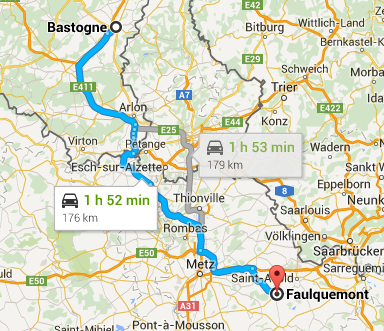
able to lick [their] wounds and rest for the long battle journey across Germany yet to come. On January 17, the division moved southward to Faulquemont, France, where it was rejoined by Colonel Roberts' Combat Command B.... For nineteen days the Tigers were engaged in a three-fold program of unit training, providing a counter-reconnaissance screen west of the Saar River, and at the same time, holding part of the Army's front line.
The weather, of course was awful and many vehicles slid off the icy roads into the ditches. They made it, though, and spent the rest of January in the Faulquemont area.

10th Armored (minus CC B) moves from Metz Jan 18

Combat Command B joined the Division at Faulquemont
[Note: Google maps are obviously contemporary. I use them to show distances and locations.]

Wednesday, January 7, 2015

17. The New Year Begins

As 1944 turned into 1945, the Battle of the Bulge continued, although it was probably clear that the Allied forces were on the offensive now. The battle around Bastogne had broken the siege, but not the ongoing fighting. The story remained the weather, the coldest weather in the area in thirty years. Here's some of the information of the last week or so from a history of the 4th Armored Division:

Friday, December 29
Weather: Arctic air, heavy snow, blizzards, greatly reduced visibility. Wounded, if not quickly evacuated, died of exposure

Saturday, December 30
Weather: Early AM fog, then clear enough for flying. Extremely cold. So cold that plasma freezes in aid stations and men die for lack of it. A wounded soldier not immediately evacuated dies of freezing

Monday, January 1, 1945
Weather: Morning cloudy and dark. Afternoon clear and cold.
In Bastogne area, all Third Army guns fire New Year's salute from 2359 to 0019. Reports that artillery causes heavy enemy losses.
Ambulance in Bastogne

Tuesday, January 2
Weather: Clear enough to fly.
Bastogne: Hitler again orders the capture of Bastogne. At 0200 the Luftwaffe bombs the 6th Armd Div west of Bastogne.

Monday, January 3
Weather: Cold, no air support possible in stormy weather.

Thursday, January 4
Weather: Miserable .

Saturday, January 6
Churchill, British leader sends letter to Roosevelt praising the bravery and skill of American soldier. Effort to heal wound caused by Montgomery. {British commander Montgomery had made some disparaging remarks about the American troops and Eisenhower's leadership.}

Sunday, January 7, 1945
Weather: Cold, deep snow on ground
Allied Leadership Crisis: Montgomery calls press conference in which he intimates that he had saved the Allies during the crisis days of the Battle of the Bulge. Newspapers in England and the United States carry the story. Many British editors enlarge on Montgomery's role. Bradley and Patton explode. Bradley holds oneof few news conferences to explain why Montgomery had been given the two American Armies. Winston Churchill later (January 17) makes a historic statement in Parliament to soothe situation.


~~~~~~~~~~

By this time, the news embargo had been at least eased. High Schuck, war correspondent for the New York Daily News, reported on January 4:
With the U.S. Third Army- As details of fighting in the early stages of [the Battle of the Bulge] emerge... it becomes more and more apparent that the initial... impetus of the German drive was broken by isolated American units which chose to fight to the last cartridge against overwhelming odds.
It was such a last-ditch effort by ... part of [the] 10th Armored Division which kept the Germans from capturing the City of Luxembourg and its road network over which Lieutenant General George S. Patton later moved his divisions to launch a counter-attack. And it was that kind of American resistance that centered around Berdorf, 17 miles northeast of the City of Luxembourg. [That is the area where most of the 10th Armored, minus Combat Command B, were located.]
Memorial in Berdorf to the 10th
The parts of the Battle away from Bastogne did not, of course, get the huge press that Bastogne did. But it allowed the Allied forces to be as successful as they were. As the 10th (minus CCB) headed back toward Metz, Prince Felix, Crown Prince of Luxembourg, visited the 10th's commander, General Morris. As Nichols reports it, he brought
Plaque on memorial in Berdorf
the heartfelt thanks of his people and declared that the Tenth had saved Luxembourg from certain capture by the Germans as a result of the courage and superior combat shown by the Armoraiders.

Wednesday, December 31, 2014

15. The Year- and the Siege- Ends


26 Dec- The siege of Bastogne, for purposes of historic record, may be considered ended at 1645 on 26 December when the 326th Airborne engineers reported contact with "three light tanks believed friendly." True, the breach in the German-held ring opened by the 4th Armored Division was narrow and precarious, but it would not be closed despite the most strenuous enemy efforts in coming days. The staunch defense of Bastogne had impeded the Fifth Panzer Army drive to the west,…

The human cost of the Bastogne battle, therefore, probably was not out of proportion to the military gains achieved.

The 101st Airborne Division suffered battle casualties numbering 105 officers and 1,536 men. CCB of the 10th Armored Division had approximately 25 officers and 478 men as battle casualties. There is no means of numbering the killed, wounded, and missing in the miscellany of unrecorded tankers, gunners, infantry, and others who shared in the defense of Bastogne.
--From THE ARDENNES: BATTLE OF THE BULGE by Hugh M. Cole

As Nichols reports in Impact:
26 Dec- The Tigers’ Christmas present, though a day later, was delivered. The iron ring of German panzers was pierced and the rescue was begun… [H]ard fighting was still required of all units. This was necessary in order to widen the corridor during the ensuing days.

Bastogne, 26 Dec 1944
27 Dec- Wounded were evacuated and supply trains wheeled in. Along with the supplies came swarms of war correspondents and official observers. The sickening sight of gutted buildings, smashed tanks and vehicles, was mute testimony of the hell that Bastogne had been for eight long days.

Painting 'Medics Moving in Near Bastogne / Relief Station at Bastogne' (Belgium) by Olin Dows, 1945

Meanwhile, the rest of the 10th Armored, minus CCB, was kept busy on the southern end of the bulge. They had been “jabbing and sparring” just north of the Saar-Moselle Triangle to keep the Germans off balance. At the center of this was Combat Command A (CCA). Their part of General Patton’s great offensive against the Bulge was a success.

28 Dec- 10th Armored’s defensive positions secured.

31 Dec- 10th Armored (minus CCB) moved south to Metz for rehabilitation and training, ending the most hotly contested battle in the Division’s brief but rugged operational history since its November baptism of fire at the swollen Moselle.


Wednesday, December 24, 2014

14. No Truce for Christmas


Exactly thirty years before the Battle of the Bulge the “miracle” of the impromptu Christmas Eve truce made history in the trenches of World War I. No such “miracle” occurred for the men in Bastogne and the surrounding area in 1944. It had been a week of continuing hell! Between December 19 and 24 Combat Command B (CCB) of the 10th Armored had fought its way around and into Bastogne. Words like “chaos, panic, and utter disorganization" were used to describe the hard-hit units.

 
On the map, the 10th Armored troops are in the right-hand side. 
  • Team O'Hara behind the German line south of Wardin; 
  • Team Cherry behind German attack line on the far right side; 
  • Team Desorby behind German attack line at the top of the map; 
  • HQ of Team Cherry in Neffe just outside the Bastogne perimeter; and 
  • CCB HQ in Bastogne.
22 Dec
The tide of battle may be about to shift though. The German thrusts have repeatedly been stalled by fuel shortages and pockets of American resistance. Better still the days of sleet and low cloud, which have protected the Germans from Allied air power, are about to end, according to the forecasters.

Meanwhile, Patton's Third Army is on the move. (The 10th Armored, part of the Third Army, was already there and engaged). Eisenhower did not believe Patton when he promised that he would be at Bastogne by today; he had to disengage his men from battle on the Saar front, execute a 90 degree change of course and move over 130,000 vehicles 75 miles to the north. And he has done just that.

23 Dec
In the U.S. Third Army area, improving weather conditions permit extensive air support, particularly in the Bastogne area, where 260 USAAF IX Troop Carrier Command C-47 Skytrains drop 334 tons (303 metric tonnes) of supplies in parapacks on several drop zones inside the besieged American positions at Bastogne.

The German forces that have bypassed Bastogne do not have the strength or supplies because of the growing effectiveness of Allied air support. The US 101st (and CCB of the 10th) in Bastogne holds out.

The circumference of the ring around Bastogne would be approximately 25 kilometres.

Much of the above information is from a World War Two Chronology.
~~~~~~~~~
The following is from Art of Manliness
On Christmas Eve, 1944, General Anthony McAuliffe, commander of the 101st Airborne Division, issued a flier to his men. It was headlined “Merry Christmas,” and the general wrote, “What’s merry about all this, you ask? We’re fighting. It’s cold. We aren’t home.” He went on to praise Allied troops for stopping flat everything the enemy was throwing at them. Then he described a story that happened two days earlier.

On December 22, the commander of the German army had sent word to McAuliffe. The enemy commander had painted a bleak picture of the Allied position, and insisted there was only one option to save the Allied troops from total annihilation.

Surrender.

When McAuliffe read the demands, he fumed, then sent back to the German commander a reply of only one word.

NUTS!

When the messenger asked for further explanation, he was told, “It’s the equivalent of saying, ‘Go to hell.’”


--from Art of Manliness

The tide is turning, but a lot of battle will continue.