Showing posts with label 101st Airborne. Show all posts

Tuesday, March 3, 2015

25. Capture of Trier


From HyperWar
26 Feb - 2 Mar 1945: Trier

As described in The Last Offensive, the capture of Trier was quick and effective. (My Dad's company was probably assigned to Combat Command B (CCB) during this period.)
The morning of 1 March General Morris sent the main body of the combat command northwest to the juncture of the Saar and the Moselle to prevent any Germans remaining in West Wall pillboxes along the Saar from falling back on Trier. ... In late afternoon, as both CCA's task force and CCB continued to run into trouble on the fringes of the city from pillboxes and 88-mm. antiaircraft pieces, Colonel Roberts, CCB's commander, ordered the commander of the 20th Armored Infantry Battalion, Lt. Col. Jack J. Richardson, to enter Trier along a secondary road between the other two attacking forces. Richardson was to head straight for the city's two Moselle bridges.

The night was clear, the moon full, and visibility excellent as Task Force Richardson in early evening started toward Trier. Entering the city before midnight, the task force encountered a German company with four antitank guns, but the surprised Germans surrendered without firing. One of the prisoners revealed that he had been detailed as a runner to notify a demolition team at one of the bridges when the Americans arrived.

Splitting his force, Richardson sent half toward each of the bridges. The northern team found its bridge blown, but the team moving to the ancient Kaiserbruecke, which had stood since the Roman occupation of Trier in the earliest days of the Christian era, reported its bridge intact. Rushing to the bridge himself in a tank, Colonel Richardson found his men under small arms fire from the far bank. Directing .50-caliber machine gun fire from his tank onto the far end of the bridge, Richardson ordered a platoon of infantry and a platoon of tanks to dash across. As the infantrymen complied, a German major and five men ran toward the bridge from the far side with detonating caps and an exploder.

They were too late.

It mattered not whether the delay in blowing the bridge was attributable to concern for the historic monument or to the fact that the German officer was drunk. What mattered was that the 10th Armored Division had a bridge across the Moselle.

By morning contingents of Combat Commands A and B had swept into all parts of the city, and the prisoner bag increased as sleepy-eyed Germans awoke to find American tanks all about them. Task Force Richardson alone took 800 prisoners. A day later, early on 3 March, troops of the 76th Division arrived to establish contact with the armor on the north bank of the Moselle.

The Orscholz Switch, the Saar-Moselle triangle, Trier, and the heavily fortified section of the West Wall around Trier--all were taken. With the success of the operation, the Third Army had torn a gaping hole in the West Wall from Pruem to a point below Saarburg.

Studying the operations map, General Patton could see two new inviting prospects before him. Either he could turn to the southeast and envelop the Saar industrial area, or he could head through the Eifel and up the valley of the Moselle to the Rhine at Koblenz.

In either case, the Germans appeared powerless to stop him.
Two press notices:
March 1 (INS) by Larry Newman- Rampaging tank and infantry fighters of the U. S. Third Army's 10th Armored Division crashed into the historic German city of Trier from three directions and swept ahead to cut off hundreds of Wehrmacht soldiers northeast of Saarburg.
1 March 1945- Official communique
The Tenth Armored "Tiger" Division entered Trier today at 1250 when task forces fought their way into the southern section of this important communications and supply center, which is the oldest city in Germany. Meanwhile, the Tenth Armored also cut the main highway...a mile northeast of Trier. This the main avenue of escape for the enemy to the north and northeast has been cut off. ...Over 800 prisoners were captured today... Total numbers of towns now taken by the Tenth Armored is 54, and the total of prisoners has swelled to 3900. --Nichols
Trier was historic and contains more important Roman ruins than any other place in Northern Europe. Some date to the bridge over the Mosel that dates to around 28 B.C. Nichols in Impact reports that the 10th's combat performance was "eminently successful." He goes on:
Few of us realized at the time that the Tenth Armored had a leading role in one of the three most important phases of the entire war.
In these few days, the 80th Medical Battalion companies saw over 900 admissions, average of over 180 per day. This high level would continue for another week before things quieted down, at least for the most part, for the rest of the month.

The end of the war in Europe is less than 10 weeks away- a "mere" 66 days. They didn't, of course know that. All they knew was that there was still more war ahead.

Monday, March 2, 2015

24. Ending February


In the chaos of the Battle of the Bulge, no end-of-month After Action Reports were filed for either December 1944 or January 1945. They resumed with February.

After Action Report
80th Medical Battalion
10th Armored Division
1 Feb – 28 Feb 1945

There were 32 officers and 363 enlisted men. During the month none of the battalion was killed and three were wounded. Nineteen reinforcements were assigned.

At all three clearing stations of the battalion in February 1945 there were:

1734 admissions
326 were returned to duty
11 died in the stations
1342 were transferred and
59 remained in station on 28 Feb

It should be noted as we have said in previous posts that most of February was quiet as the 10th Armored was waiting for the attack on the Saar-Moselle Triangle to resume. Of the admissions listed above 1020 of them (59%) were between 23 Feb and 28 Feb after the action resumed. 90% of the admissions were transferred. The deaths all occurred after 20 Feb.

The report stated that the medical evacuation channels functioned effectively during the month of February.

A couple recommendation notes were added:

1) The recommendation is repeated that closer planning between the Operations Section and the medical Department should be effected so that adequate medical support can be given the division during an operation rather than “in the dark" or "on the spot" medical support.

2) That wheel ambulances be either replaced by properly equipped half-track ambulances in medical detachments; or that such armored ambulances be added to all infantry and tank medical detachments. The operation of wheel ambulances is both dangerous and expensive.

Fredrick D. Loomis
Captain, MAC.,
Battalion S-3


Fighting FOR The Tigers
Here, from The Last Offensive, is what also was happening at the end of the month behind the scenes.
While the events were taking place beyond the Saar, General Patton had been fighting a rear guard action against return of the 10th Armored Division to the SHAEF reserve. Eisenhower, seeking to prevent another Bulge-type problem due to lack of coordination had been insisting on more control. On 23 February all Patton could achieve was a 48-hour respite. When that period expired, he pleaded with the 12th Army Group commander, General Bradley, for help. Bradley himself took responsibility for letting Patton use the armor until nightfall of 27 February for the express purpose of taking Trier.

[By nightfall on the 27th] Trier still lay some six miles away and the appointed hour for release of the 10th Armored Division had come, General Patton again had to appeal to General Bradley for continued use of the armor until Trier fell. Having had no word from SHAEF on keeping the division, Bradley told him to keep going until higher authority ordered a halt. And, the 12th Army Group commander added, he would make it a point to stay away from the telephone.
All would continue as they were.

Thursday, February 26, 2015

23. Crashing Through the Saar-Moselle Triangle


The Switch Line was an outgrowth of the fortification of the Siegfried Line. It was about two Km wide and consisted of 75 bunkers and over 10 Km of tank barriers like "dragon's teeth. It's purpose was to deny access to the high ground above Trier at the northern end of the Switch.


19-20 February 1945-
The Tenth was marshalled at Perl, about 6 miles south of Nennig on this afternoon. A plan was selected from the three prepared and a sudden directive came down that they were to depart at 0700 the next morning.

The Tenth was not prepared for the suddenness. Large numbers of the Division were on R & R in Paris. But they were located and the Tigers moved out by 1800. They raced 75 miles that night and began the attack at 0700 as scheduled.

21-25 February 1945-
In the course of these few days the 10th Armored would overrun the Saar-Moselle Triangle even through some of the most heavy fortifications in the world. Praise came from many, including General George Patton who termed this battle "one of the war's most audacious operations."

As can be seen in the maps on the left and below, different task forces and Combat Commands carried out the greater plans. In a mere 48 hours, the 10th Armored had blitzed 85 square miles of Germany and working with the 94th Infantry, captured 1200 prisoners and 23 towns. In those 48 hours the stage was set to capture Trier.

The next three days were utilized for that goal.

The successful completion needed a crossing of the Saar. Obstacles were encountered, a new bridgehead had to be established after an earlier one had to be abandoned, apparently due to human error. At 0900 on February 24 the armored infantry battalions assembled at Ayl (lower center of map at left). At 1600 the soldiers, aided by a smokescreen generated by the 81st Chemical Co., began an assault under heavy and continuous fire.

By noon on February 25 all the armored infantry battalions of the Tenth Armored were across the Saar.

Thursday, February 19, 2015

21. Replenished, Refreshed and Ready


9-10 Feb 1945-
Nichols reports that the 10th received sudden orders to move north to again unite with the XX Corps of the Third Army at Metz. By dusk on he 10th they were there. There was a secretiveness to the move as they removed all identification from vehicles and put away their shoulder patches. Even with that, Nichols says
a French boy of seven bravely approached a Tiger staff officer and in perfect English said, "Welcome back to Metz, Tenth Armored Tigers.
It hadn't been two months since the 10th had been diverted from breaking through defensive Siegfried Line near Saarbrucken. They were now returning to the Saar-Moselle triangle with new strength and refreshed for the job ahead. They were the only division remaining which had participated in the November-December assault. Nichols comments that this time they were
to set a model for tank-infantry teamwork, as the Tigers were to race through an infantry bridgehead to seize important objectives deep in the enemy's rear area.
The Triangle-
The Saar-Moselle Triangle is defined by the Moselle River on the west, the Saar on the east and, across the southern end, a part of the Siegfried Line. From Wikipedia: The whole
Line stretched more than 630 km (390 mi) and featured more than 18,000 bunkers, tunnels and tank traps. It went from Kleve on the border with the Netherlands along the western border of the old German Empire as far as the town of Weil am Rhein on the border to Switzerland. It was planned starting in 1936 and built between 1938 and 1940.
The portion of the Line the Tigers were responsible for was a small section, but important to the overall goals to capture the Triangle. For that to be successful they had to capture Metz and then, with that accomplished they could capture Trier. The Germans had fortified the two rivers, the Line as well as a nineteen mile long ridge line that bisected the triangle north and south.

10-18 Feb 1945-
The Tenth began an intensive training program. The Divisions battalions, which had been impacted by the Bulge, were strengthened with experienced replacements. Plans were prepared at headquarters and then translated into field orders, A, B, and C. The Division could then be put into motion at a moment's notice.

In short, the 10th was ready to go. Their movements were mocked by Axis Sally, the radio propagandist, by calling the Tenth- the "Ghost Division." They were not the only division to be so named, but they took it as a mark of honor.

Wednesday, February 4, 2015

20. Ending an Uneventful Month


Nichols in Impact describes the end of January into the beginning of February 1944 for the now reunited 10th Armored.
The Division’s stay in the Faulquemont area was uneventful. Except, perhaps, for the unique arrangement which permitted one train a day to come from the German side to our area without having to suffer the indignity of being shelled by the Tigers. In this way, the Germans who worked on the German side but who loved behind American lines, could go to work every day and return in safety.
He then adds another tidbit of trivia:
And for once, the rear echelon found itself in surroundings far inferior to those which favored the front line Tigers. Nowhere, for example, was it possible to get a bath in the Division Headquarters area. But up front, all was serene as the Tigers there wallowed in hot water, thanks to the good conditions of the area’s water works.
So with this break in the action, I have had some time to do some thinking again of what I am writing about.

1. The recent discussions in the media about the current movie, American Sniper, made me stop and think about the “glorification” of war we often see and read. I have had no false impressions about war, even before starting this. War is not something to be glorified and those who fight it are not to be made into some demi-gods. We glorify war when we take war- and the actions of some soldiers- and turn it into propaganda. At this writing I have not seen American Sniper, so I can’t comment on that. But to really understand war and its horrors is not a glorification. Perhaps in the long run to really show it in it’s awful detail is the best way to work against war. This is something I know I will return to later.

2. I mentioned in another post the “fog of war.” Chaos is perhaps a better word for it. Bastogne in the midst of the Battle of the Bulge may be a paradigm for it. The time of the siege of Bastogne was a time when there was no control- things were on a knife’s edge. At times it appears that primal reactions were the only thing that made sense. What will happen between now and the end of the war will be nowhere near that level of chaos. The war has made its final turn and the Allies are in control, whatever that will mean.

3. What I also find interesting is that from this point on in the war, the actions in Europe that my dad was involved with were actions that we don’t hear a lot about. These aren’t the BIG actions. But they were important and the war was far from over. Between now and VE Day in May the war for the 10th will be:
  • Clearing the Saar-Moselle Triangle
  • Capture of Trier
  • Race to the Rhine
  • Battle for Crailsheim
For now, though, the 10th is regrouping and training for what will yet happen.

Sunday, January 18, 2015

18. Battle Weary and Ready to Move On


16-18 Jan 1945:
The weary, triumphant Tigers (Combat Command B) take their final ride through Bastogne’s rubble strewn streets. There had just been another blizzard. [Note: There are different dates in different places on the date of leaving Bastogne by CC B and the 10th Armored.]

No matter- the Battle of the Bulge was over and the outcome of the war was pretty much a certainty. It was a bloody and traumatic time. Over 600,000 Americans (and another 120,000 Allied soldiers) were involved. Over 300,000 German troops were active. That means over 1,000,000 soldiers were involved in that small area of northeast France.
  • American Casualties: 19,000 killed, 47,500 wounded, 23,000 captured or missing.
  • British Casualties: 200 killed, 969 wounded, and 239 missing.
  • German Casualties: 67,200 – 100,000 killed, missing, captured, or wounded
It is interesting to note that there are no "After Action Reports" for the 80th Medical Battalion for December 1944 and January 1945. In the intensity of the battle, the ongoing uncertainties and the general "fog of war" many papers and records were lost. They will resume in February.

Many times in my reading I have come across the term, "Fog of War" in relation to the Battle of the Bulge. I did some digging and with the help of Wikipedia (naturally) I found that the term goes back to the late 19th Century and is credited to the German von Clausewitz in the early 19th Century. Here's Wikipedia's opening statement:
The fog of war (German: Nebel des Krieges) is the uncertainty in situational awareness experienced by participants in military operations. The term seeks to capture the uncertainty regarding one's own capability, adversary capability, and adversary intent during an engagement, operation, or campaign. ...
War is the realm of uncertainty; three quarters of the factors on which action in war is based are wrapped in a fog of greater or lesser uncertainty. A sensitive and discriminating judgment is called for; a skilled intelligence to scent out the truth.
Carl von Clausewitz
As I have read through many accounts of the Battle of the Bulge and looked at countless pictures of all kinds of armored warfare and medical care in the midst of World War II, I have been struck by the incredible intensity that these men were under. For many the days were almost certainly endless, one day running into the next. Nights being regularly disturbed by artillery, hunger and cold. Days blinded by snow or the intense light when the sun came out and reflected from the ground.

Those in Bastogne had the worst of it- far greater than any of us can ever imagine. The sublimation of fear was a necessity. What does that do to a person psychologically? How does a soldier cope other than to grow emotionally numb? I would think that if you allowed any emotion to break through, the worry would be that all the emotions would break as well. One thing that could not be afforded was that kind of flood.

But even beyond Bastogne itself, the ongoing uncertainty of the direction of the war would have been just as difficult to cope with. Somewhere in the midst of all that was the one medic that I would come to know as my father. I am learning more about his life than I have ever known. I, too, leave the Battle of the Bulge now. I have thought and read about it for months in preparation for these weeks. I will continue to research and read for it is an important part of our American history. But I also feel it had a great deal to do with who my Dad became- and perhaps in some family memory who I have become as well.
~~~~~~~~~~~~~

17-18 Jan 1945

Sgt. Benjamin B. Barenbrugge wrote a memoir years later that is in the Wartime Memories Project. He tells what happened next, as the 10th Armored returned to its original mission- the clearing of the Saar-Moselle Triangle. He describes in general what the rest of the war would be for the 10th:
Our orders were to push the Germans further back into Germany. The Army engineers literally built our bridges as we moved. They got a good workout. The Germans blew every bridge across each river we had to cross. Our engineers built new bridges made of large rubber pontoons, lashed together and anchored to the riverbed. They placed steel grid channels across the pontoons; spaced far enough apart to accommodate our tank tracks. I really felt sorry for these engineers, as this was a hard and dangerous job. German artillery would blow these bridges up as fast as they built them. Then our artillery had to go to work and knock out their artillery. Sometimes this went on for days. When we could, we would rest up in some little nearby town. We made three major river crossings: the Saar, Rhine and Danube. We took over 150 towns and cities. Some of the major ones were Trier, Kaiserlautern and Mannheim.
--Wartime Memories Project

The rest of the 10th Armored had been in Metz since the end of December. There Nichols describes that they were
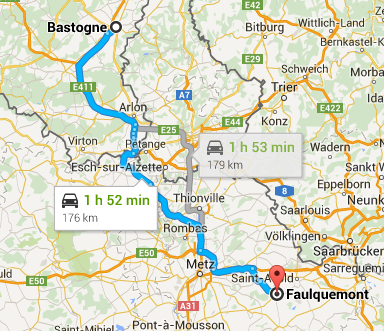
able to lick [their] wounds and rest for the long battle journey across Germany yet to come. On January 17, the division moved southward to Faulquemont, France, where it was rejoined by Colonel Roberts' Combat Command B.... For nineteen days the Tigers were engaged in a three-fold program of unit training, providing a counter-reconnaissance screen west of the Saar River, and at the same time, holding part of the Army's front line.
The weather, of course was awful and many vehicles slid off the icy roads into the ditches. They made it, though, and spent the rest of January in the Faulquemont area.

10th Armored (minus CC B) moves from Metz Jan 18

Combat Command B joined the Division at Faulquemont
[Note: Google maps are obviously contemporary. I use them to show distances and locations.]

Wednesday, January 7, 2015

17. The New Year Begins

As 1944 turned into 1945, the Battle of the Bulge continued, although it was probably clear that the Allied forces were on the offensive now. The battle around Bastogne had broken the siege, but not the ongoing fighting. The story remained the weather, the coldest weather in the area in thirty years. Here's some of the information of the last week or so from a history of the 4th Armored Division:

Friday, December 29
Weather: Arctic air, heavy snow, blizzards, greatly reduced visibility. Wounded, if not quickly evacuated, died of exposure

Saturday, December 30
Weather: Early AM fog, then clear enough for flying. Extremely cold. So cold that plasma freezes in aid stations and men die for lack of it. A wounded soldier not immediately evacuated dies of freezing

Monday, January 1, 1945
Weather: Morning cloudy and dark. Afternoon clear and cold.
In Bastogne area, all Third Army guns fire New Year's salute from 2359 to 0019. Reports that artillery causes heavy enemy losses.
Ambulance in Bastogne

Tuesday, January 2
Weather: Clear enough to fly.
Bastogne: Hitler again orders the capture of Bastogne. At 0200 the Luftwaffe bombs the 6th Armd Div west of Bastogne.

Monday, January 3
Weather: Cold, no air support possible in stormy weather.

Thursday, January 4
Weather: Miserable .

Saturday, January 6
Churchill, British leader sends letter to Roosevelt praising the bravery and skill of American soldier. Effort to heal wound caused by Montgomery. {British commander Montgomery had made some disparaging remarks about the American troops and Eisenhower's leadership.}

Sunday, January 7, 1945
Weather: Cold, deep snow on ground
Allied Leadership Crisis: Montgomery calls press conference in which he intimates that he had saved the Allies during the crisis days of the Battle of the Bulge. Newspapers in England and the United States carry the story. Many British editors enlarge on Montgomery's role. Bradley and Patton explode. Bradley holds oneof few news conferences to explain why Montgomery had been given the two American Armies. Winston Churchill later (January 17) makes a historic statement in Parliament to soothe situation.


~~~~~~~~~~

By this time, the news embargo had been at least eased. High Schuck, war correspondent for the New York Daily News, reported on January 4:
With the U.S. Third Army- As details of fighting in the early stages of [the Battle of the Bulge] emerge... it becomes more and more apparent that the initial... impetus of the German drive was broken by isolated American units which chose to fight to the last cartridge against overwhelming odds.
It was such a last-ditch effort by ... part of [the] 10th Armored Division which kept the Germans from capturing the City of Luxembourg and its road network over which Lieutenant General George S. Patton later moved his divisions to launch a counter-attack. And it was that kind of American resistance that centered around Berdorf, 17 miles northeast of the City of Luxembourg. [That is the area where most of the 10th Armored, minus Combat Command B, were located.]
Memorial in Berdorf to the 10th
The parts of the Battle away from Bastogne did not, of course, get the huge press that Bastogne did. But it allowed the Allied forces to be as successful as they were. As the 10th (minus CCB) headed back toward Metz, Prince Felix, Crown Prince of Luxembourg, visited the 10th's commander, General Morris. As Nichols reports it, he brought
Plaque on memorial in Berdorf
the heartfelt thanks of his people and declared that the Tenth had saved Luxembourg from certain capture by the Germans as a result of the courage and superior combat shown by the Armoraiders.

Wednesday, December 31, 2014

15. The Year- and the Siege- Ends


26 Dec- The siege of Bastogne, for purposes of historic record, may be considered ended at 1645 on 26 December when the 326th Airborne engineers reported contact with "three light tanks believed friendly." True, the breach in the German-held ring opened by the 4th Armored Division was narrow and precarious, but it would not be closed despite the most strenuous enemy efforts in coming days. The staunch defense of Bastogne had impeded the Fifth Panzer Army drive to the west,…

The human cost of the Bastogne battle, therefore, probably was not out of proportion to the military gains achieved.

The 101st Airborne Division suffered battle casualties numbering 105 officers and 1,536 men. CCB of the 10th Armored Division had approximately 25 officers and 478 men as battle casualties. There is no means of numbering the killed, wounded, and missing in the miscellany of unrecorded tankers, gunners, infantry, and others who shared in the defense of Bastogne.
--From THE ARDENNES: BATTLE OF THE BULGE by Hugh M. Cole

As Nichols reports in Impact:
26 Dec- The Tigers’ Christmas present, though a day later, was delivered. The iron ring of German panzers was pierced and the rescue was begun… [H]ard fighting was still required of all units. This was necessary in order to widen the corridor during the ensuing days.

Bastogne, 26 Dec 1944
27 Dec- Wounded were evacuated and supply trains wheeled in. Along with the supplies came swarms of war correspondents and official observers. The sickening sight of gutted buildings, smashed tanks and vehicles, was mute testimony of the hell that Bastogne had been for eight long days.

Painting 'Medics Moving in Near Bastogne / Relief Station at Bastogne' (Belgium) by Olin Dows, 1945

Meanwhile, the rest of the 10th Armored, minus CCB, was kept busy on the southern end of the bulge. They had been “jabbing and sparring” just north of the Saar-Moselle Triangle to keep the Germans off balance. At the center of this was Combat Command A (CCA). Their part of General Patton’s great offensive against the Bulge was a success.

28 Dec- 10th Armored’s defensive positions secured.

31 Dec- 10th Armored (minus CCB) moved south to Metz for rehabilitation and training, ending the most hotly contested battle in the Division’s brief but rugged operational history since its November baptism of fire at the swollen Moselle.


Wednesday, December 24, 2014

14. No Truce for Christmas


Exactly thirty years before the Battle of the Bulge the “miracle” of the impromptu Christmas Eve truce made history in the trenches of World War I. No such “miracle” occurred for the men in Bastogne and the surrounding area in 1944. It had been a week of continuing hell! Between December 19 and 24 Combat Command B (CCB) of the 10th Armored had fought its way around and into Bastogne. Words like “chaos, panic, and utter disorganization" were used to describe the hard-hit units.

 
On the map, the 10th Armored troops are in the right-hand side. 
  • Team O'Hara behind the German line south of Wardin; 
  • Team Cherry behind German attack line on the far right side; 
  • Team Desorby behind German attack line at the top of the map; 
  • HQ of Team Cherry in Neffe just outside the Bastogne perimeter; and 
  • CCB HQ in Bastogne.
22 Dec
The tide of battle may be about to shift though. The German thrusts have repeatedly been stalled by fuel shortages and pockets of American resistance. Better still the days of sleet and low cloud, which have protected the Germans from Allied air power, are about to end, according to the forecasters.

Meanwhile, Patton's Third Army is on the move. (The 10th Armored, part of the Third Army, was already there and engaged). Eisenhower did not believe Patton when he promised that he would be at Bastogne by today; he had to disengage his men from battle on the Saar front, execute a 90 degree change of course and move over 130,000 vehicles 75 miles to the north. And he has done just that.

23 Dec
In the U.S. Third Army area, improving weather conditions permit extensive air support, particularly in the Bastogne area, where 260 USAAF IX Troop Carrier Command C-47 Skytrains drop 334 tons (303 metric tonnes) of supplies in parapacks on several drop zones inside the besieged American positions at Bastogne.

The German forces that have bypassed Bastogne do not have the strength or supplies because of the growing effectiveness of Allied air support. The US 101st (and CCB of the 10th) in Bastogne holds out.

The circumference of the ring around Bastogne would be approximately 25 kilometres.

Much of the above information is from a World War Two Chronology.
~~~~~~~~~
The following is from Art of Manliness
On Christmas Eve, 1944, General Anthony McAuliffe, commander of the 101st Airborne Division, issued a flier to his men. It was headlined “Merry Christmas,” and the general wrote, “What’s merry about all this, you ask? We’re fighting. It’s cold. We aren’t home.” He went on to praise Allied troops for stopping flat everything the enemy was throwing at them. Then he described a story that happened two days earlier.

On December 22, the commander of the German army had sent word to McAuliffe. The enemy commander had painted a bleak picture of the Allied position, and insisted there was only one option to save the Allied troops from total annihilation.

Surrender.

When McAuliffe read the demands, he fumed, then sent back to the German commander a reply of only one word.

NUTS!

When the messenger asked for further explanation, he was told, “It’s the equivalent of saying, ‘Go to hell.’”


--from Art of Manliness

The tide is turning, but a lot of battle will continue.