Monday, May 25, 2015

39. Memorial Day 2015


Dedicated to the gallant and victorious men and women who participated in the Battle of the Bulge, World War II, 16 December 1944 through 25 January 1945 in Belgium and Luxembourg. The greatest battle ever fought by the United States Army. Presented by the veterans of the Battle of the Bulge on 16 December 1986.


[Sidenote: A number of posts on Facebook this year have noted that Memorial Day is not Veteran's Day- that Memorial Day is to remember those who died in (or as the result of) the wars. I appreciate that distinction.]

Saturday, May 23, 2015

38. Feeling Better At Home


May 23, 1945
The Entry in My Grandmother's Diary for the Day

Got a letter from Buddy that he wrote on VE Day.
So now I feel better.

Take this comment as a follow up to the one she wrote on VE Day:
O God just think of the mothers that their boys won’t be coming home
and realize that for the previous 15 days, over two weeks, she had no doubt been holding her thoughts, prayers and fears deep inside. She never commented on it in the diary. The dread and anxiety must have been overwhelming. Or perhaps in the past nearly nine months she had found a way to live without thinking about it. Perhaps that is why the daily entries in the diary are often just the mundane.

Today, she could feel better. What a relief!

But with all the elation and relief, the dread must have remained. The war was not over. Germany had surrendered; Japan fought on. Did they know that a massive invasion, far greater than D-Day was being planned? Were they all just living in the uncertainty of what  troops would be transported to the Pacific for an invasion of Japan?

What we do know is that for the next several months the Tigers would remain in Austria, relaxing, waiting, wondering, and being an occupation force, albeit a friendly one.


Obviously I am not sure this was in the letter, but it, along with the other two I posted on VE Day could very well have been there.
 

Friday, May 8, 2015

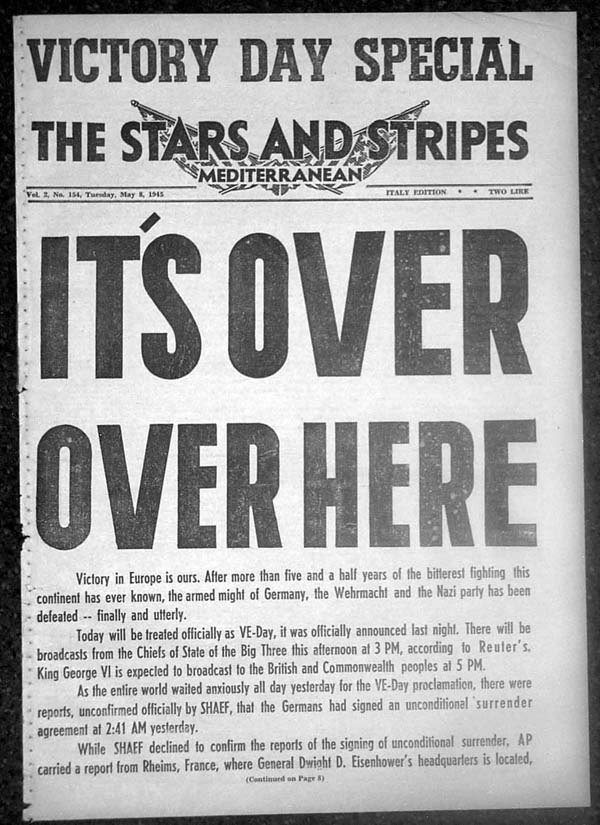
37. VE Day

May 8, 1945
The entry in my grandmother's diary for the day:
Tuesday- This is V.E. Day. The war is over and O God just think of the mothers that their boys won’t be coming home.
From Nichols:
General Paul Newgarden's careful pre-battle training paid huge dividends and General Morris' leadership propelled the Division through every battle with distinction. The price paid for victory was dear. Tigers' losses were heavy, Almost 5,000 were killed or wounded. The Tigers' combat achievements are a matter of record. More that 56,000 enemy were taken prisoner and 650 towns and cities were captured. More important, the Tigers played a key role in many of the war's greatest battles. The epic stand at Bastogne [note: only recently receiving the credit] will never be forgotten nor will the spectacular successes in the Saar-Moselle Triangle be overlooked by military historians. The capture of Trier was most important in the U. S. Third Army's effort to pierce the vaunted West Wall. And finally, every step of the way from Cherbourg to the Brenner Pass, a distance of 600 miles, was made possible by the Tigers' courage, initiative, and persistence. They has met and defeated the enemy's best. Hitler's earlier boast that American soldiers would never stand and fight must have provided slim comfort to the Nazi commanders who, one by one, capitulated in late April of 1945.

Two postcards sent by my father to his family back in Pennsylvania of the Garmisch-Partenkirche area where they ended the war.


Monday, May 4, 2015

36. The Last Kilometer


1 May 1945
VE Day for the Tigers

From Nichols:
At Ulm, they had turned south once more and, attacking into the rugged Alps on two parallel routes, [the Tigers] had reached Mittenwald on one route and had captured Imst in Austria after crossing the border at Fussen on the other when the war ended.

Prior to April 30, a final Tenth Armored Division Field Order was issued which called for the capture of Innsbruck, Austria. However, the Germans had already blown out great chunk of the road…. [T]he Innsbruck Field Order had to be abandoned…. So intent were the Tigers in grinding out the last mile, that they even tried to roll their tanks over the railroad tracks. The going was extremely difficult, however, as the steel rails did not match the width of the tank tracks…. The last kilometer was now a matter of record anyway. The big fight was over. And Garmisch-Partenkirchen, in the opinion of the Armoraiders, was a fine place to end the war on this, the last day of April of 1945. The final major battle operation of the Tiger Division consumed seven weeks. This period was marked with continuous combat, sleepless days and nights, sizzling speed, strained nerves, rain, snow, mud, and cold. But at last, the ordeal was over.

Elsewhere in the European Theater:
April 29: Adolf Hitler and Eva Braun exchange wedding vows in Adolf Hitler's underground Berlin bunker.

General Vietinghoff, the German commander of Axis forces in Italy, signs documents surrendering to the Allies.

April 30: The newly wed Hitlers commit suicide in the Berlin bunker. Joseph and Magda Goebbels follow suit, murdering their six children before taking their own lives.

Soviet Union forces capture the Reichstag.

May 1: Admiral Karl Dönitz, Adolf Hitler's handpicked successor, establishes a government in Flensburg to control Nazi Germany following Adolf Hitler's suicide.

May 2: Some 490,000 German soldiers in Italy lay down their weapons, honoring the terms of the unconditional surrender signed by Vietinghoff three days earlier.

May 3: Red Army units link up throughout Berlin as German resistance ends, completing the capture of the capital of the Third Reich.

Hamburg, Germany, and Innsbruck, Austria, fall to the Allies.

May 4: German troops surrender en masse throughout northern Germany and the Netherlands.

May 5: German and Allied officials meet in Reims, France, to reach agreement on the terms of Germany's capitulation.

The German army lays down its weapons throughout Bavaria.

U.S. forces liberate French and Austrian officials -- including premiers Reynaud, Daladier, Blum, and Schuschnigg -- from captivity in Austria.

Friday, May 1, 2015

35. End of April Report

After Action Report
80th Medical Battalion
10th Armored Division
1 April – 30 April 1945

There were 31 officers and 364 enlisted men, four less than in March. During the month three enlisted men of the battalion were killed, two officers and four enlisted men were wounded and four were reported missing. Twenty-one reinforcements were assigned to the battalion.

At all three clearing stations of the battalion in April 1945 there were:

2267 admissions (nearly 600 less than March)
153 were returned to duty
19 died in the stations
1987 were transferred and
9 remained in station on 31 March

These numbers were lower than March, indicative of the overwhelming force of the Tigers in the movements of April and the decreasing efficiency of the German troops. More than half of the admissions for the month occurred by the 12th. Captain Loomis commented that the figures are the sum total “of those of the clearing stations and include personnel of units attached or supporting the division and enemy personnel cleared through division medical installations as well as 10th Armored Division personnel.

It was reported that providing both expendable and non-expendable supplies was adequate during the period. In addition, medical evacuation channels functioned efficiently during the period.

Recommendations:
(1) That medical personnel supporting combat troops not be assigned to screen and process enemy hospital installations, but that this chore be given to a static unit.
(2) That the replacement of medical officers and medical administrative officers be expedited in the case of units actively engaged in combat.

Fredrick D. Loomis
Captain, MAC.,
Battalion S-3

Monday, April 27, 2015

34. A Liberating Unit


According to the US Holocaust Museum:
 As it [The Tenth Armored] drove into the heartland of Bavaria, the "Tiger" division overran one of the many subcamps of Dachau in the Landsberg area on April 27, 1945.

The 10th Armored Division was recognized as a liberating unit by the US Army's Center of Military History and the United States Holocaust Memorial Museum in 1985.
-Link
It seems there were six camps in the Landsberg area. First, some of what  is reported at Wikipedia:
The American forces allowed news media to record the atrocities, and ordered local German civilians and guards to reflect upon the dead and bury them bare-handed. After the liberation of the camp it became a displaced person camp. Consisting primarily of Jewish refugees from the Soviet Union and the Baltic states, it developed into one of the most influential DP camps in the Sh'erit ha-Pletah. It housed a Yiddish newspaper (the Yiddishe Zeitung), religious schools, and organizations to promote Jewish religious observance. Tony Bennett was one of the soldiers who liberated the camp.
-Link
U.S. Soldier at Gate of Landsberg. USHM
I gather that the 103rd Infantry Division was one of the major units. Here's some of their report:
From REPORT AFTER ACTION: The Story of the 103D Infantry Division, pp. 131-135

At Landsberg the men of the 103d Infantry Division discovered what they had been fighting against. They found six concentration camps where victims of the super race had died by the thousands of atrocities, starvation, and exposure. The grounds of the camp were littered with the skeletonized bodies of Jews, Poles, Russians, French, and un-Nazified Germans. Every evidence was that they were only the latest of untold thousands who had suffered and died in these six concentration camps, a few among the hundreds which dotted Grossdeutschland. German civilians who were forced by the 411th guards to pick up these wasted bodies for decent burial sniveled that they had not known such things existed. They had not known, yet they had spent their lives in this town of 30,000 which was ringed by six horror camps.
-Link
The 103rd, it should be noted, was, along with the 44th Infantry and the Tenth Armored, working together on a combined spearhead, the Tenth's armor leading the way.

Some videos are archived at the US Holocaust Museum. Here's a link to one of them.

From all I can find, it would appear that my Dad's company was most likely with CC B during this time and in all probability was not part of the liberation of the camp. I wouldn't be surprised, however, that when the Division was reunited all kinds of stories were shared. It is possible however that he was with CC R, the reserve command, which was near Landsberg during this time.

Nichols, interestingly, does not appear to discuss the concentration camp liberation in Impact. He does relate a story of liberating a POW camp where some former Tigers were held following Bastogne. I may continue to explore this. With my Dad married to a Jewish woman from Brooklyn, I would venture a guess that he may have had some interest in this.

Saturday, April 25, 2015

33. To the Danube

This is part of a series following my father's 10th Armored Division in World War II seventy years ago. He was a medic with the 80th Medical Battalion assigned to the 10th Armored, part of Patton’s Third Army.


The Tenth processed their 2,000 prisoners from Crailsheim and sent them to the rear. They were given a new battle assignment. They were to shift their attention and combat power toward Heilbronn where the fighting was continuing.


CC A was directed to seize Oehringen while CC B was placed in "reserve" on a two-hour alert.

12 - 15 April
When forces entered Oehringen they were met with fierce resistance. As Nichols reports it,
Nazi fanaticism was slow to die as Wehrmacht and civilians alike resisted with renewed determination.
Heavy and timed artillery bursts were ordered and the efforts prevailed with the town captured on 13 April. When all the units met with the infantry units east of Heilbronn that mission was ended.

Heilbronn, April 1945
16 - 24 April
It was now time to make the move south toward the Danube and Austria. For several days there were obstacles that acted as hidden allies of the enemy. The minefields, roadblocks and blown bridges, says Nichols, "strained the already overworked Tiger engineers' efforts to clear a path for continued advance." By April 18, things began to move and all three Combat Commands became a formidable array of six armored columns. Town after town was captured. On April 19 the terrain of steep hills and deep valleys slowed the advance but later in the day the Tigers again triumphed and forged ahead 17 miles to the Rems River.

The plateau could have been easily defended by the enemy. But the Germans were sure that the Americans would attack from the west and were thus unable to halt the advance from the north.

CC B crossed the river after seizing two bridges while, to the west CC A hit a 40 MPH pace as a result of Tigers who carried a power saw to rip through roadblocks. At Lorch they scared of an enemy plane about to land and an enemy train. The train got up steam and raced away surprised by the Tigers in the town. Movement of all Combat Commands quickly captured more territory. By April 22 all were closing in on the same target of Kircheim and burst ahead to the Danube at Ehingen.

Stuttgart was virtually surrounded. Harassment of the enemy continued. The capture of Kircheim marked the end of German resistance in the area as more than 400 prisoners were taken and, more importantly, the Stuttgart-Munich autobahn was cut. Nichols writes then,
One of the most important days in the Tenth's memorable history was April 22, the day Chamberlain's forces steamrolled to the Danube. By midnight they succeeded in capturing a bridge at Ehingen. Then on April 23 [they] destroyed a German supply column.... On April 24 the Reserve Command sped across the [Danube] and headed for Ulm. At this point the Tigers were further south than any other American unit.... The Third Reich was almost a dead government now, as allied armies to the north were inflicting terrible punishment on the beaten enemy. The Tenth Armored was no poised above the great National Redoubt, an area which the Germans claimed could never be captured by the Americans. However, this claim, along with their hopes for a "thousand Year Reich" died when the Tiger's mailed fist hit them again and for the last time to end the war in the first week of May 1945