Showing posts with label Hiroshima. Show all posts

Sunday, August 9, 2015

43. Another Bomb


The 10th Armored, still in Europe, must have wondered what all this could mean for them.....

On the day of the nuclear strike on Thursday, August 9, 1945, the population in Nagasaki was estimated to be 263,000, which consisted of 240,000 Japanese residents, 10,000 Korean residents, 2,500 conscripted Korean workers, 9,000 Japanese soldiers, 600 conscripted Chinese workers, and 400 Allied POWs. That day, the Boeing B-29 Superfortress Bockscar, commanded by Major Charles Sweeney, departed from Tinian's North Field just before dawn, this time carrying a plutonium bomb code named "Fat Man". The primary target for the bomb was Kokura, with the secondary target, Nagasaki, if the primary target was too cloudy to make a visual sighting. When the plane reached Kokura at 9:44 a.m., the city was obscured by clouds and smoke, as the nearby city of Yawata had been firebombed on the previous day. Unable to make a bombing attack on visual due to the clouds and smoke and with limited fuel, the plane left the city at 10:30 a.m. for the secondary target. After 20 minutes, the plane arrived at 10:50 a.m. over Nagasaki, but the city was also concealed by clouds. Desperately short of fuel and after making a couple of bombing runs without obtaining any visual target, the crew was forced to use radar in order to drop the bomb. At the last minute, the opening of the clouds allowed them to make visual contact with a racetrack in Nagasaki, and they dropped the bomb on the city's Urakami Valley midway between the Mitsubishi Steel and Arms Works in the south, and the Mitsubishi-Urakami Ordnance Works in the north. After 53 seconds of its release, the bomb exploded at 11:02 a.m. at an approximate altitude of 1,800 feet.

The atomic bombing made Nagasaki the second and, to date, last city in the world to experience a nuclear attack.

Nagasaki:
39,000–80,000 killed

-Link
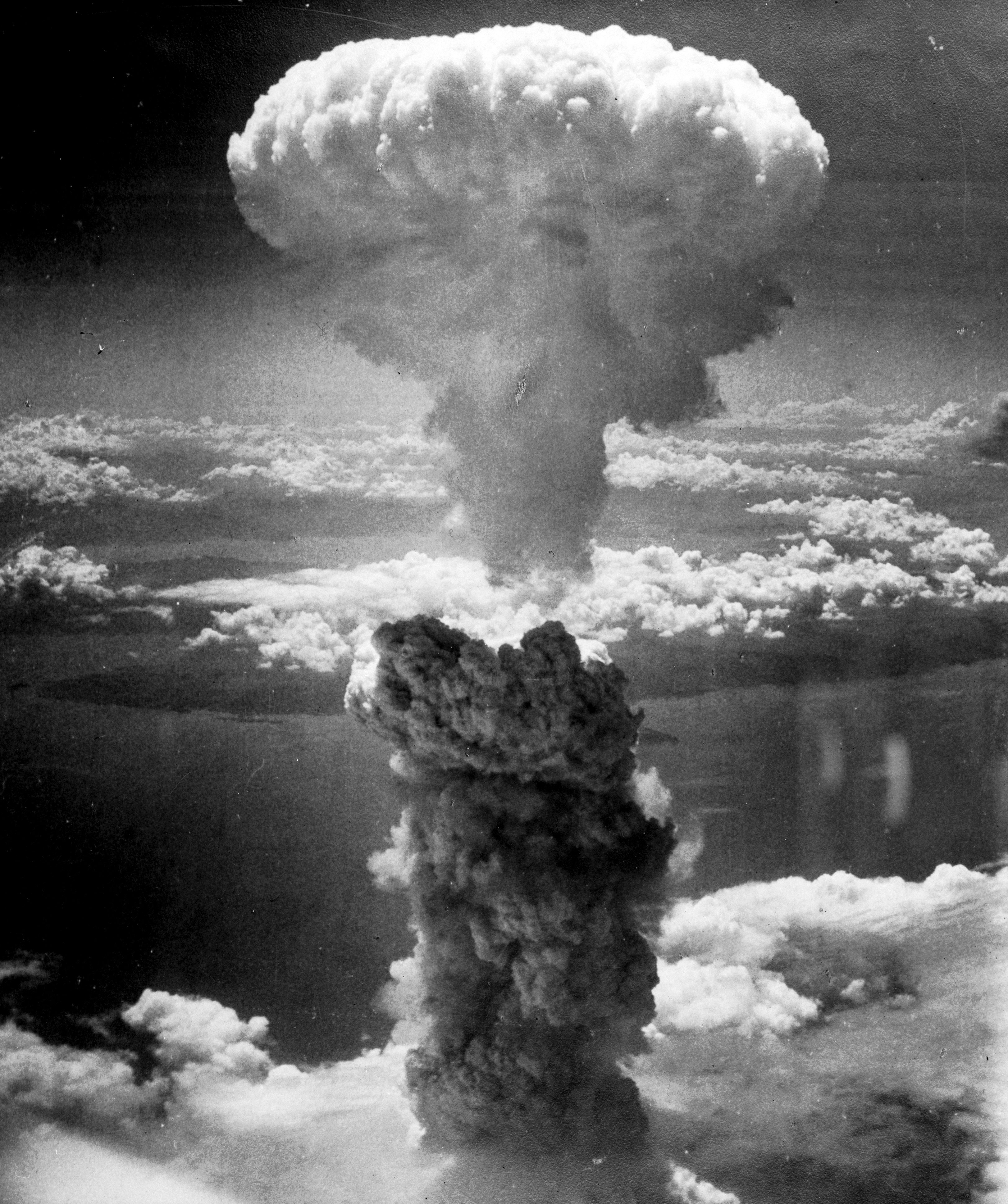
[Sidenote: In my grandmother's diary these is absolutely no mention of either Hiroshima or Nagasaki. She did not mention many world or news events at any time, but somehow, from our advantage point 70 years later it is interesting. My guess is that the average person was not really aware of the significance of the bomb at that time. Even with the over-the-top language and description given in the news, it would all have been science fiction to many.]

Here's the lead from the New York Times story on Nagasaki:
Guam, Thursday, Aug. 9 -- Gen. Carl A. Spaatz announced today that a second atomic bomb had been dropped, this time on the city of Nagasaki, and that crew members reported "good results."

The second use of the new and terrifying secret weapon which wiped out more than 60 percent of the city of Hiroshima and, according to the Japanese radio, killed nearly every resident of that town, occurred at noon today, Japanese time. The target today was an important industrial and shipping area with a population of about 258,000.

The great bomb, which harnesses the power of the universe to destroy the enemy by concussion, blast and fire, was dropped on the second enemy city about seven hours after the Japanese had received a political "roundhouse punch" in the form of a declaration of war by the Soviet Union.
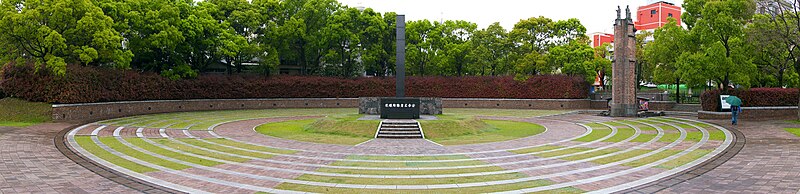
Nagasaki Memorial at Ground Zero

Lord, make me an instrument of thy peace.
Where there is hatred, let me sow love;
Where there is injury, pardon;
Where there is doubt, faith;
Where there is despair, hope;
Where there is darkness, light;
Where there is sadness, joy.

O divine Master, grant that I may not so much seek
To be consoled as to console,
To be understood as to understand,
To be loved as to love;
For it is in giving that we receive;
It is in pardoning that we are pardoned;
It is in dying to self that we are born to eternal life.

Thursday, August 6, 2015

42. Hiroshima


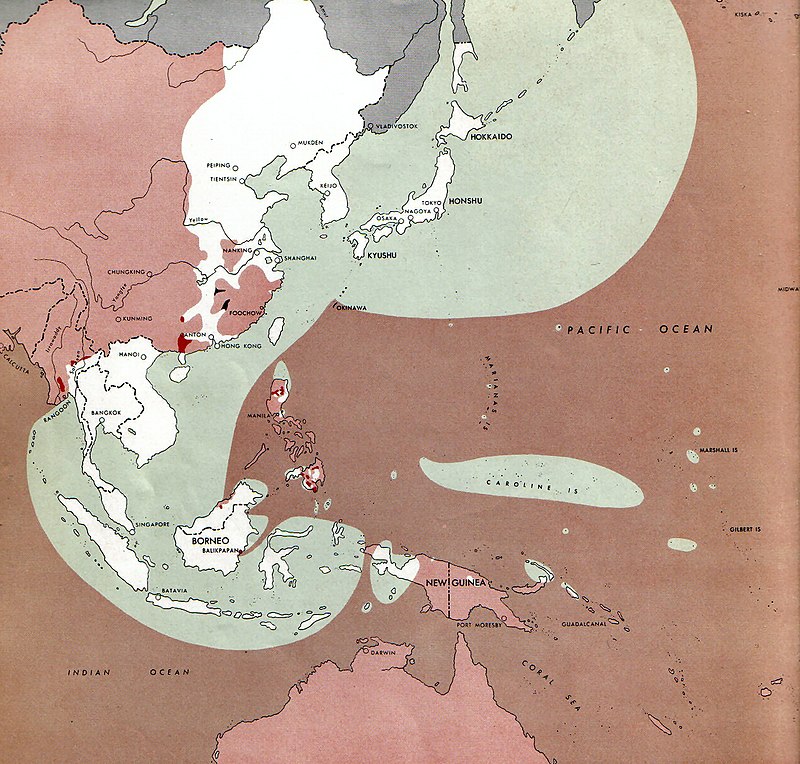
Situation of Pacific War by August 1, 1945. Japan still had control of all of Manchuria, Korea, Taiwan and Indochina, a large part of China, including most of the main Chinese cities, and much of the Dutch East Indies.

Even before the surrender of Nazi Germany on May 8, 1945, plans were underway for the largest operation of the Pacific War, Operation Downfall, the invasion of Japan.[7] The operation had two parts: Operations Olympic and Coronet. Set to begin in October 1945, Olympic involved a series of landings by the U.S. Sixth Army intended to capture the southern third of the southernmost main Japanese island, Kyūshū.[8] Operation Olympic was to be followed in March 1946 by Operation Coronet, the capture of the Kantō Plain, near Tokyo on the main Japanese island of Honshū by the U.S. First, Eighth and Tenth Armies.
World War II Museum, New Orleans

A study from June 15, 1945, by the Joint War Plans Committee,[14] who provided planning information to the Joint Chiefs of Staff, estimated that Olympic would result in between 130,000 and 220,000 U.S. casualties of which U.S. dead would be the range from 25,000 to 46,000.

In preparation for dropping an atomic bomb on Hiroshima, U.S. military leaders decided against a demonstration bomb, and against a special leaflet warning, in both cases because of the uncertainty of a successful detonation, and the wish to maximize psychological shock. No warning was given to Hiroshima that a new and much more destructive bomb was going to be dropped.

Truman delayed the start of the [Potsdam] summit by two weeks in the hope that the bomb could be tested before the start of negotiations with Stalin. The Trinity Test of July 16 exceeded expectations. On July 26, Allied leaders issued the Potsdam Declaration outlining terms of surrender for Japan. It was presented as an ultimatum and stated that without a surrender, the Allies would attack Japan, resulting in "the inevitable and complete destruction of the Japanese armed forces and just as inevitably the utter devastation of the Japanese homeland". The atomic bomb was not mentioned in the communiqué. On July 28, Japanese papers reported that the declaration had been rejected by the Japanese government.

During the night of August 5–6, Japanese early warning radar detected the approach of numerous American aircraft headed for the southern part of Japan. ... An alert was given and radio broadcasting stopped in many cities, among them Hiroshima. The all-clear was sounded in Hiroshima at 00:05. About an hour before the bombing, the air raid alert was sounded again, as [the weather reconnaissance plane]  flew over the city. It broadcast a short message which was picked up by Enola Gay. It read: "Cloud cover less than 3/10th at all altitudes. Advice: bomb primary." The all-clear was sounded over Hiroshima again at 07:09.

At 08:09 Tibbets [pilot of the Enola Gay] started his bomb run and handed control over to his bombardier, Major Thomas Ferebee. The release at 08:15 (Hiroshima time) went as planned, and the Little Boy containing about 64 kg (141 lb) of uranium-235 took 44.4 seconds to fall from the aircraft flying at about 31,000 feet (9,400 m) to a detonation height of about 1,900 feet (580 m) above the city. Enola Gay traveled 11.5 mi (18.5 km) before it felt the shock waves from the blast.

After the Hiroshima bombing, Truman issued a statement announcing the use of the new weapon. He stated, "We may be grateful to Providence" that the German atomic bomb project had failed, and that the United States and its allies had "spent two billion dollars on the greatest scientific gamble in history—and won." Truman then warned Japan:
"If they do not now accept our terms, they may expect a rain of ruin from the air, the like of which has never been seen on this earth. Behind this air attack will follow sea and land forces in such numbers and power as they have not yet seen and with the fighting skill of which they are already well aware."
20,000+ soldiers killed
70,000–146,000 civilians killed

-Link

In Europe, the 10th Armored was still sitting as an occupation Army in Bavaria.

I wonder what they thought?